


Founders often think how to register a company in the UK is the hard part. It isn't. The online process takes 24 hours and costs £50. What actually trips people up comes after missed tax filings, incomplete PSC registers, share structures that create future disputes, and compliance deadlines they didn't know existed.
This guide walks through every step so you get it right the first time and avoid the expensive mistakes later.
Register in Under 24 Hours for £50
The fastest way to register a limited company Companies House accepts is through their online portal. Submit your application, pay £50, and you'll receive your Certificate of Incorporation within 24 hours on working days. Same-day processing costs £78 if you submit before 3pm.
Before you start:
- Your proposed company name (must end in "Limited" or "Ltd")
- A UK registered office address
- Full details of all directors and shareholders
- Your SIC code (business activity classification)
Standard online registration with Companies House costs £50, and same-day registration costs £78. If you choose to use a formation agent to handle the process instead of doing it directly yourself, you'll pay an additional £10 – £100 depending on what services are included such as a registered office address, company secretary service, or help with HMRC registration. For most founders, the most cost-effective approach is paying the £50 directly to Companies House and managing the process yourself.
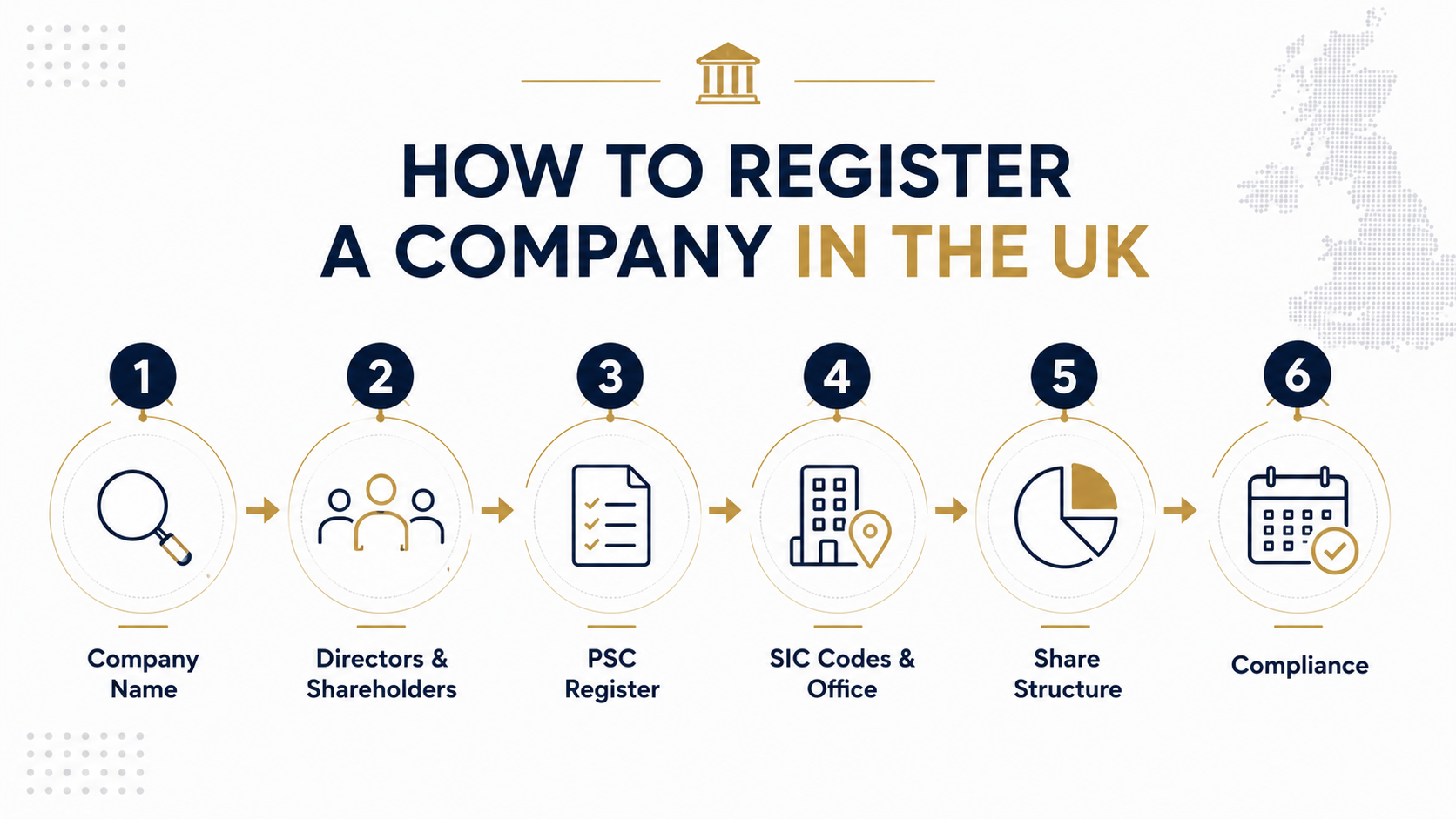
Step 1: Choose and Check Your Company Name
Your company name must be unique and registered on the Companies House database. Use the Companies House name checker a name too similar to an existing registration will be rejected.
Watch for:
- Sensitive words — "Royal", "Bank", "Institute", or "British" require special permission
- Trade mark conflicts — Companies House doesn't check trade marks. You must search the IPO trade mark register separately. Incorporating a name that infringes an existing mark is a legal liability.
Your registered company name and your trading name are different things. Once you set up a limited company in the UK, you can trade under any name just declare it on your website and invoices.
Before you begin the registration process, gather your proposed company name (which must end in Ltd or Limited), a UK registered office address, the full details of all directors including their name, date of birth, nationality, residential and service addresses, shareholder information, and your SIC code that describes your business activity. Having all this information prepared and ready will make your submission to Companies House much smoother and faster.
Step 2: Directors and Shareholders
Directors
You need at least one real person as a director (16 or older). When you register a limited company Companies House will require their full legal name, date of birth, nationality, residential address, and a service address (the public-facing one on the register). Most founders use their registered office address as their service address to keep their home address private.
Shareholders
You need at least one shareholder, who can also be a director. Before you set up a limited company in the UK, agree the share split with co-founders. Changing equity structure after incorporation means additional Companies House filings and tax complications.
For most early-stage startups, issue 100 ordinary shares at £1 nominal value simple, clean, and easy to split in future rounds.
You can register a UK limited company with just a single director who is also the sole shareholder; there's no legal requirement for multiple people. However, many co-founded businesses choose to have multiple directors and shareholders from day one. If you have co-founders, it's essential to agree on your equity split before incorporation rather than trying to change it afterwards, which involves additional Companies House filings and potential tax complications.
You can also have corporate shareholders (other companies) in addition to or instead of personal shareholders, which adds flexibility depending on your business structure.
Step 3: Complete Your PSC (Persons with Significant Control) Register
The PSC register is where most founders slip. A PSC is anyone who:
- Owns more than 25% of shares
- Controls more than 25% of voting rights
- Has the right to appoint or remove the majority of directors
When you register a limited company in the UK, you must list all PSCs at incorporation. If two founders own 50% each, both are PSCs and both must be registered. An incomplete PSC register is a compliance failure that Companies House will act on.
Step 4: SIC Codes and Registered Office
SIC Codes
Standard Industrial Classification codes describe what your business does. You can assign up to four. Search the Companies House SIC list and pick the closest match. You can update this later through your annual Confirmation Statement. Don't let it slow you down.
Registered Office
Your registered office must be a real UK address (not a PO box) where official correspondence is received and publicly listed. You can use your home, a business address, or pay a formation agent or accountant for a registered office service (usually £50–£100/year). Many founders prefer this to keep their home address off the public register.
Step 5: Share Structure and Articles of Association
When you set up a limited company in the UK through Companies House, you'll confirm in your articles of association the internal rules governing the company. For most early-stage founders, the default model articles provided automatically are perfectly adequate. You only need custom articles if you're encoding specific shareholder rights, veto provisions, or investor protections from the start.
Your share structure at incorporation sets the baseline for all future dilution. Agree the split with co-founders before you incorporate, changing it after involves additional filings and tax implications.
Step 6: Register for Corporation Tax and Critical First Filings
Receiving your Certificate of Incorporation means you've completed how to register a company in the UK. But incorporation is not the finish line, it's the starting point for compliance.
Within three months of starting to trade, you must register for Corporation Tax with HMRC or face penalties. Beyond that, here are the filings most founders miss:
Confirmation Statement - Due within 14 days of each incorporation anniversary, every year through the Companies House online portal. It confirms your company details are current. Fail to file two years in a row and Companies House will strike you off.
First Accounts - Due 21 months after incorporation for your first period, then 9 months after your accounting year end annually. A late filing incurs penalties.
VAT Registration - Mandatory once taxable turnover exceeds £90,000 in any rolling 12-month period. Register voluntarily before that if you have input tax to reclaim.
PAYE - Register before you pay any salary, including to yourself as a director.
Set calendar reminders for all of these on incorporation day. Trying to reconstruct the compliance calendar months later will cost you time and money.
FAQs
1. How long does it take to register a company in the UK?
Using the Companies House online portal, most applications are approved within 24 hours on working days. Same-day registration is available for £78 if you submit before 3pm. Paper applications take 8–10 working days.
2. How much does it cost to register a limited company Companies House?
Standard online registration costs £50. Same-day costs £78. If you use a third-party formation agent to register a limited company Companies House, you'll pay an additional £10–£100 depending on what's bundled. Some include a registered office address, company secretary service, or HMRC help. For most founders, the direct Companies House route is sufficient.
3. What's a PSC and why do I need one?
A PSC (Person with Significant Control) is anyone who owns more than 25% of your company's shares, controls more than 25% of voting rights, or can appoint/remove the majority of directors. You must register all PSCs when you incorporate. If you're a sole founder, you're the PSC. If you have co-founders owning 25%+ each, they're all PSCs. An incomplete PSC register is a compliance failure that Companies House acts on get it right at incorporation.
Planning your business structure before incorporation? Read: How to Start a Startup in the UK in 2026
Pre-Submission Checklist
- Company name checked for availability and trade mark conflicts
- UK registered office address confirmed
- Director details ready (name, DOB, nationality, service and residential addresses)
- Share structure agreed and shareholder details prepared
- PSC register completed for all qualifying individuals
- SIC code(s) selected
- Articles of association confirmed (model or custom)
- HMRC Corporation Tax registration calendared within 3 months of trading
Knowing how to register a company in the UK is straightforward. What catches most founders is the compliance calendar that follows. Build it on day one, before you incorporate.
Sources: Based on current Companies House regulations, HMRC Corporation Tax guidance, and UK company law as of 2026.


