

British founders are spending more on workplace culture, flexible working, and employee well-being. Yet UK employee engagement remains low, staff turnover is rising, and many companies are solving the wrong problem.
The UK startup world has a real management problem.
The UK startup world faces a real management problem, not a funding problem, not a talent pipeline problem, and not a hybrid work problem, even though those issues receive far more attention; until the ecosystem starts naming the problem correctly, no amount of ping-pong tables or away days will fix it.
Here's what the data actually shows.
The Misdiagnosis Running Through the Ecosystem
When someone leaves a startup, they usually say they got a better offer, so the founder adjusts the salary band, and sometimes the person stays, but often they leave anyway.
The offer was real, but it wasn't the cause.
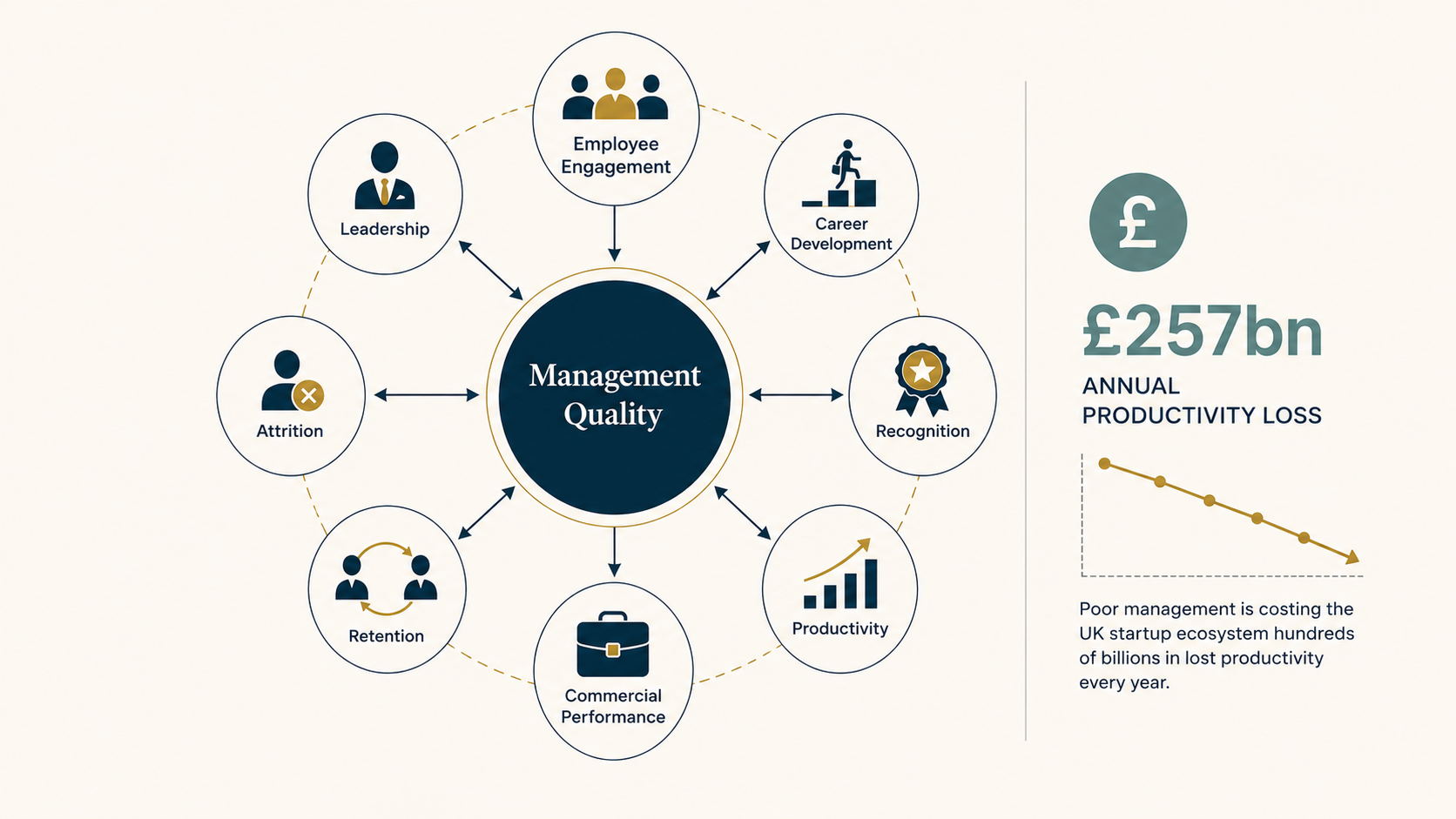
Low UK employee engagement, rising absence, high employee attrition, and stagnant productivity all trace back to the same root causes, which are undertrained managers, weak development pathways, poor recognition and benefits that miss the mark.
The Chartered Institute of Personnel and Development’s (CIPD's) Resourcing and Talent Planning surveys consistently identify three primary drivers of voluntary turnover: better pay and benefits elsewhere (44% of leavers), lack of career development (32%), and poor management or leadership (27%).
Pay gets cited because it's the reason people give, it’s not always the real reason, it's the permission slip.
People don't generally leave for better pay; they leave because they've already mentally left and better pay finally gives them the excuse.
With a great manager and leader in place, employees' commitment to stay is 94%. A poor manager with a poor leader reduces that figure to 19%.
That's a 75-percentage-point gap driven entirely by one variable, yet the startup ecosystem's response to retention problems is rarely "let's examine our management quality."
It's another salary review. Another benefits benchmark. Another company offsite day.
Why UK Startups Are Particularly Exposed
The UK has a specific problem here that goes beyond individual companies.
Only 10% of UK employees are fully engaged at work, with 90% described as disengaged or actively disengaged. Overall, UK employee engagement has risen 3% to 65%, its first increase since the pandemic, but the UK still sits in the bottom 39% globally. Poor engagement costs the UK economy an estimated £257 billion a year in lost productivity.
This isn't an enterprise problem that startups are insulated from. It's an ecosystem-wide condition that startups inherit the moment they start hiring.
The average attrition rate in the UK tech sector in 2025 is 19%, above the European average of 17.4% and representing an 11% increase from 2024. UK tech startups are losing people faster than their European counterparts and the gap is widening.
The structural reason: startups promote on merit, not management readiness. The best engineer becomes the engineering manager. The best salesperson becomes the head of sales. Individual excellence is treated as a proxy for leadership capability, when it isn't.
This is how you get what the data keeps showing: poor management creating disengaged teams, disengaged teams producing underperforming companies, and finally, underperforming companies blaming the market.
What the Ecosystem Is Getting Wrong
The UK startup conversation around culture has almost entirely shifted to policies rather than practice.
Remote work policies.
Hybrid frameworks.
Four-day working weeks.
Mental health apps.
These are all legitimate considerations, but they're environmental factors, not management factors, and the data is increasingly clear about which one matters more.
Over one in three workers (35%) do not feel comfortable discussing high or extreme stress with their manager. This is precisely what management failure is.
No flexible working policy fixes a team lead who doesn't know how to have a human conversation.
About 34% of UK workers say they're considering leaving their job in 2026, with over half of those who feel undervalued planning to quit unless recognition and rewards improve.
Recognition, again, is a management behaviour, not a policy, and that only happens in one-to-ones and team meetings, not in employee handbooks.
The entire ecosystem has responded to a poor management problem with a policy solution.
That's why UK employee engagement hasn't moved meaningfully in years.
The Cost Nobody Is Calculating
The UK average employee turnover rate is currently 34% per year (CIPD), meaning a typical UK business loses one in three employees annually, and replacing that departure costs an average of £30,614.
For a 20-person startup at average turnover, that's six or seven departures a year.
At £30,614 each, you're looking at £180,000–£210,000 annually in replacement costs alone. That's before accounting for lost institutional knowledge, disrupted team dynamics, and the productivity gap while roles remain open.
Most startup founders track burn rate obsessively, but very few calculate their management-driven employee turnover cost.
These numbers are interlinked, where one feeds the other.
What Needs to Change in the Ecosystem
This isn't an argument for more HR processes or heavier management structures, it's an argument for the ecosystem to reframe what good workplace culture in the UK actually means.
Good culture is what your managers do on a Tuesday afternoon when someone on their team is struggling, and nobody's watching.
The UK startup ecosystem has built a sophisticated vocabulary around funding, product, and growth, but you see, it has a relatively underdeveloped vocabulary around management quality - how to assess it when hiring, how to build it intentionally, and how to identify when it's failing before someone hands in their notice.
That needs to change, not because it's the right thing to do, though it is, but because engaged employees are 23% more profitable for their organisations while disengaged employees are 2.6 times more likely to leave, compounding both productivity and retention costs.
UK employee engagement culture is a commercial variable, and the ecosystem hasn't fully internalised that yet.
Related: Beyond London: The UK Tech Hubs Where Real Growth Is Actually Happening in 2026
Sources: Mollearn UK Employee Statistics 2026 (April 2026) · CIPD Resourcing and Talent Planning Survey 2026 · Oxford Economics Cost of Brain Drain Study · Grove HR State of UK SME HR 2026 (March 2026) · Stribe UK Employee Retention Statistics 2026 · Ravio 2026 Compensation Trends Report · SD Worx UK Workforce Report 2026 · Gallup State of the Global Workplace 2026


