Nscale just raised the largest Series C in European history and the investor list reads like a who's who of the global compute race.
Every serious conversation about AI eventually lands on the same bottleneck.
Is it about the models?
No. The data? Not quite.
It is also not the talent pipeline.
Yes, you are correct, it is the compute.
The physical AI infrastructure, the AI data centres, the GPU clusters, the power, the cooling all of that has to exist before any of the rest of it can run at scale.
It is unglamorous, but it is enormously capital-intensive and it is arguably the most strategically important layer of the entire AI economy right now.
Most companies trying to build AI services don't own any of this.
They rent space in someone else's AI data centre and hope there's capacity when they need it. It's like being a restaurant that doesn't own its kitchen: you're stuck with whatever the landlord offers and paying whatever they decide to charge.
Nscale, a British-headquartered company founded by Josh Payne in 2024, has decided to build their own kitchen. Their own whole restaurant, actually.
The investor roster that changes the conversation
In March 2026, Nscale raised $2 billion in a Series C, the largest in European history valuing the company at $14.6 billion.
Which sounds impressive until you look at who invested.
NVIDIA. Citadel. Jane Street. Dell. Point72.
This isn't a list of venture capitalists throwing money at a pitch deck. These are chip manufacturers, the world's sharpest hedge funds, and AI hardware companies that have been in this game for decades.
When NVIDIA invests in an AI infrastructure business, it is not writing a cheque for financial returns alone. It is actively placing a strategic bet on who is going to be deploying its hardware at scale.
Three new board members joined alongside the round: Sheryl Sandberg, Susan Decker, and Nick Clegg. The former Meta COO, a seasoned Silicon Valley board operator, and a former Deputy Prime Minister on the same board, at a company most people in Britain haven't heard of yet.
So What Actually Makes Them Different?
The basic idea is that Nscale owns the whole stack.
The buildings.
The power grid.
The GPU clusters.
The software running on top.
Most competitors own maybe one or two pieces of that puzzle but Nscale owns all of it.
You must be wondering what the actual impact of that is.
Well, they can build GPU clusters with 10,000+ cards in one place.
Their competitors generally can't and there's a reason why. Dense GPU clusters like that need dedicated power AI infrastructure and cooling systems and real estate planning. It's easier to rent space and hope. It's harder to build it yourself, but better.
The money flows to Nscale instead of to a landlord and that matters when you're scaling something this capital-intensive.
Where They're Actually Building
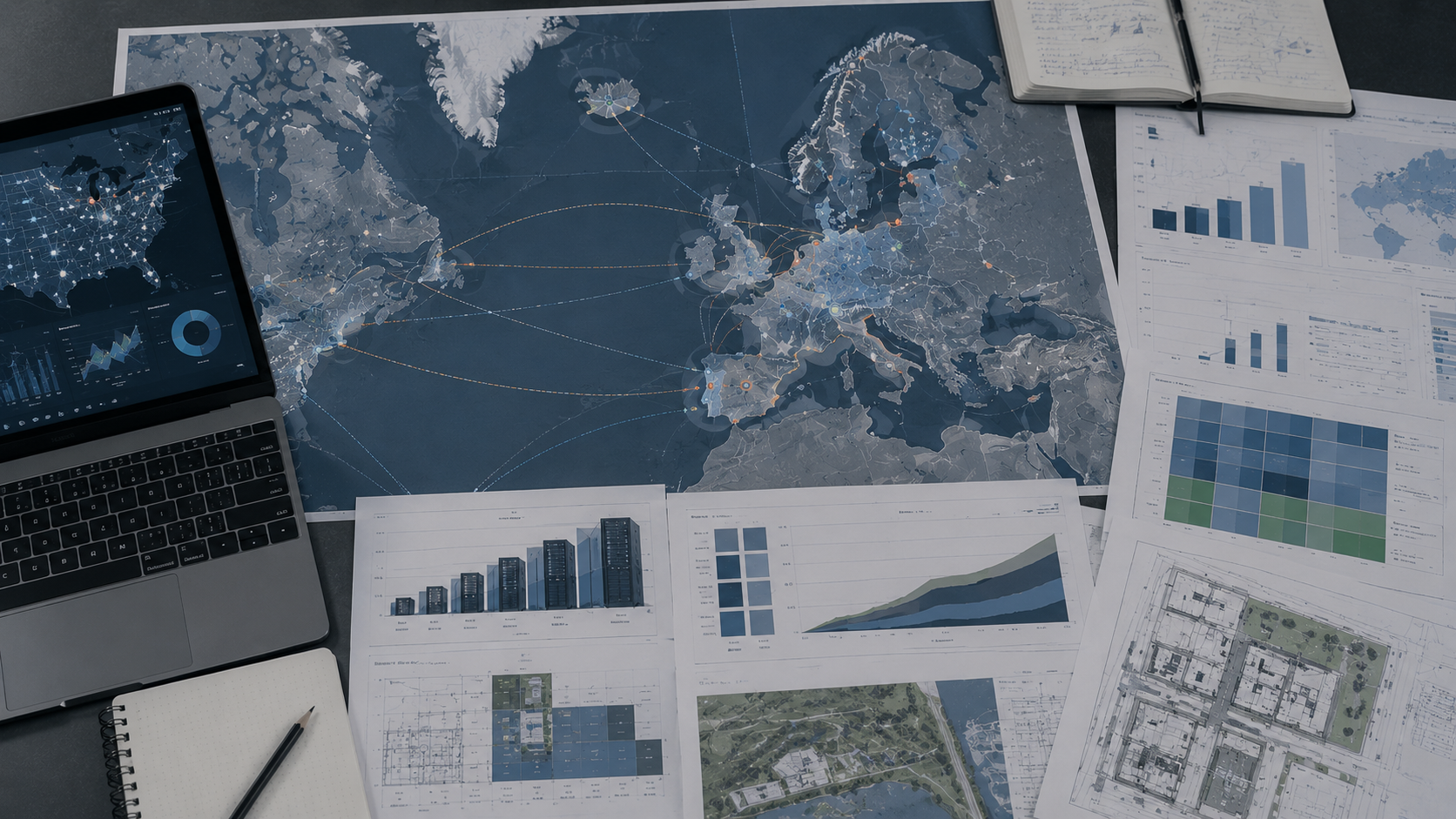
They've got AI data centre sites scattered across Norway, the UK, Portugal, Iceland, and the US. But the real story is in the Arctic.
Narvik, in northern Norway. It's freezing, has abundant hydropower, and the Norwegian government basically wants them to build there (sovereign financing helps). It's genuinely one of the few places on Earth where you can build massive AI infrastructure at scale without the power bill bankrupting you.
There was supposed to be an OpenAI project there called Stargate Norway. It fell apart. Microsoft called Nscale and said they'd take the spot instead.
That tells you something about how urgent the AI compute shortage actually is.
"This is the fourth industrial revolution. Over the next five years, AI will be integrated into every industry, every product, and every job… This is leading to the largest infrastructure buildout in human history. Nscale is leading this buildout. We are building the foundation that the market sits on - the engine of superintelligence." Josh Payne, CEO and Founder, Nscale
You could roll your eyes at that. CEOs say grand things all the time. But consider who was in the room when he said it - and then signed the paperwork anyway.
The numbers beyond the headline
The $2 billion Series C isn't even the whole picture. Before that, they had locked in $1.4 billion in debt financing. Then in May 2026, another $790 million from a consortium of European banks specifically to expand the Narvik site by 115MW.
It's becoming the biggest AI infrastructure investment in Norwegian history.
On the customer front, Nscale has agreed to deliver 66,000 NVIDIA Rubin GPUs to Microsoft at its Start Campus site in Portugal. That is a significant AI compute commitment - the kind that doesn't get signed unless both parties are serious.
When a deal with OpenAI collapses and Microsoft fills the gap within months, you are not dealing with a struggling company.
You are dealing with the sort of cloud infrastructure that the world's most serious AI buyers urgently need and cannot easily find elsewhere.
Payne's deployment targets: 150,000 GPUs by end of 2026.
350,000 by end of 2027.
Those numbers are absurd. Anyone can make promises about deployment targets.
But when you've already got Microsoft signing contracts and $2 billion in the bank and the chip manufacturers funding you?
The bar for hitting those numbers feels a lot lower.
Why This Matters For The UK
Nscale is headquartered in London. The founder (Australian, originally) basically pivoted a crypto mining company into AI infrastructure as the Bitcoin market shifted.
Now he's building AI data centres across the UK, the Arctic, and Portugal.
The typical story about AI compute is American: AWS, Google, Microsoft, CoreWeave - all domestic players.
Nscale is making it a European story. A British-headquartered company building on Arctic hydropower and delivering AI hardware at scale to the world's biggest tech companies.
The UK government made noise about a £2 billion AI infrastructure pledge.
That made headlines.
What Nscale is actually building right now quietly, at scale, with real customer commitments isn't getting the same attention. It should be.
The Real Question
The headline numbers are extraordinary, but here's what actually matters:
What does not yet exist is proof that Nscale can build at the speed and quality that hyperscale customers demand consistently, across multiple geographies, over an extended period.
UK AI infrastructure is not a niche story. It is one of the most consequential questions in British tech right now: who controls the AI compute layer, who owns the AI data centres, who powers the models that the rest of the economy will increasingly depend on.
Nscale has made a very large, very public bet on the answer being them.
That's what everyone with skin in the game is actually watching.