

Britain has a wind problem, not the wind itself necessarily, but the wiring.
So, Scotland generates more clean electricity than the transmission network can carry south, and rather than let the grid buckle, the National Energy System Operator (NESO) pays wind farms to switch off and gas plants to switch on in their place, a practice known as wind curtailment. Thermal constraint costs - the technical name for this juggling act - reached £1.7 billion in the year to March 2025, up 64% on the year before, as 13% of Britain's potential wind output went unused. NESO's own forecast puts the annual bill at £6.4–8.3 billion by 2030 if nothing changes.
“There will be more and more times with surplus generation.”— Jason Mann, senior managing director, FTI Consulting
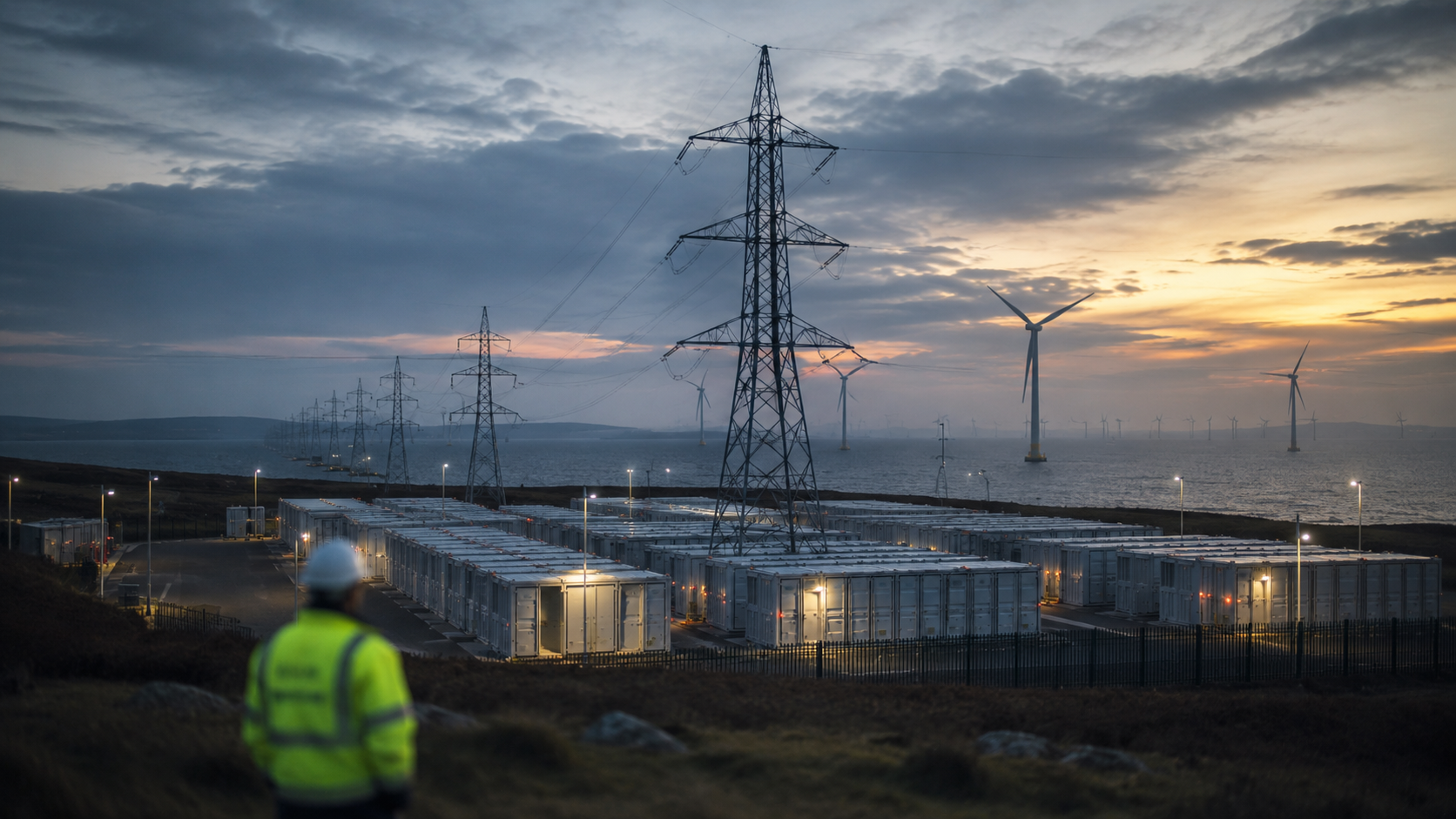
Battery storage in the UK exists to close exactly that gap - catching the wind when the wires can't carry it, releasing it when the grid actually needs it.
Where would you put the next battery, if the choice were yours: closer to the wind or closer to the demand?
The scale of the build-out
Battery storage in the UK, is measured in grid-scale batteries, commercial-scale BESS assets typically above 5MW, reached 7.5 GW of installed power capacity by the end of 2025. Output from Great Britain's batteries hit 2.3 TWh over the year, discharged at 85% round-trip efficiency, slightly ahead of pumped storage. Growth crept along through the late 2010s and accelerated sharply from 2022, helped by standalone storage being freed from a slower planning process back in 2020.
The Clean Power 2030 target calls for 23–27 GW of battery storage capacity by the end of the decade - three to four times what's operating today. Reaching that means the next five years have to outbuild the last eight, and battery storage investment is arriving fast enough to make that plausible, if not yet certain.
Why the bottleneck persists
England took 74% of GB's battery output in 2025, Scotland 24% - up from 17% the year before which tells its own story: storage is following the wind north, even as the wind itself struggles to get south.
One live policy debate has closed, in July 2025, government concluded its Review of Electricity Market Arrangements (REMA) by ruling out zonal pricing, splitting the wholesale electricity market into regional zones - judging a seven-year rebuild of the market's plumbing not worth the investor uncertainty it would create. It opted instead for a reformed national pricing model. That decision is settled.
The grid connection queue is not.
Growth in battery storage in the UK has run headlong into it: before reform, the queue held somewhere between 700 and 770 GW of generation and storage applications, roughly four times what Clean Power 2030 actually needs. NESO's Target Model Option 4+ (TMO4+) reforms, live since June 2025, swapped first-come-first-served queuing for a readiness test, and the first results cut 153 GW of battery storage projects out of the queue entirely. What remains is still enormous: connection agreements are expected for more than 80 GW of battery energy storage by 2035.
That bottleneck hasn't disappeared, but it has moved from planning permission to physical grid capacity.
One battery, three wind farms
The clearest illustration of what's at stake sits between Inverness and Aberdeen, deliberately placed to soak up power from three constrained offshore wind farms, namely - Viking, Moray East, and Beatrice - that, between them, can't always get their electricity south.
Zenobē's Blackhillock site went live in 2024 as the world's first battery to deliver synthetic inertia through grid-forming inverters while also trading energy commercially, and NESO expects it to lower consumer bills by more than £170 million over 15 years.
“This is a major accomplishment and brings us a step closer to this goal.”— Fintan Slye, CEO, NESO, on Blackhillock's commercial operations
Zenobē has since expanded the same playbook to Kilmarnock South and Eccles, the latter backed by a £220 million debt package, one of the largest single-asset battery financings in Europe, as part of a wider £750 million bet on Scottish storage.
So if one company's Scottish pipeline can absorb this much curtailed wind, what does that suggest about how many more Blackhillocks the grid actually needs?
The startups building the flexibility layer
The startups building out battery storage in the UK take three distinct approaches.
First, Field has taken the most direct route, which is to buy land, build batteries, and sell both the power and the grid services through lithium-iron-phosphate systems, a strategy the industry calls revenue stacking. It was founded in 2021 by former Bulb co-founder Amit Gudka, the company raised £77 million in 2022 and £200 million from DIF Capital Partners in 2023 and has since expanded into long duration energy storage - batteries that discharge for sixteen to twenty-two hours rather than the usual two- after winning a place in Ofgem's first long duration energy storage cap-and-floor window this June.
Habitat Energy on the other hand takes the opposite route; it owns no batteries at all. The Oxford-based optimiser, bought by Quinbrook Infrastructure Partners in 2021, uses AI-driven trading to extract value from other people's assets across the wholesale market, the Balancing Mechanism, and NESO's ancillary services suite; its managed portfolio has grown more than elevenfold since the acquisition.
Lastly, Axle Energy works the demand side of the same problem, turning home batteries, EV chargers and heat pumps into a virtual power plant rather than building anything grid-scale itself, and raised fresh growth funding this July as part of a wider European wave of flexibility-platform investment.
These are all three different bets on the same trade: own the asset, manage someone else's, or aggregate thousands of small ones.
Which of these three models would you back if it were your money?
The market that stopped paying
We think the more revealing test is what's happened to the market that made UK batteries profitable in the first place.Frequency response services like Dynamic Containment, Dynamic Moderation and Dynamic Regulation, keep grid frequency within a whisker of 50Hz, has been well saturated by the fleet built to serve them.
“We're delighted to be launching Dynamic Containment.”— Kayte O'Neill, head of markets, National Grid ESO, at the service's 2020 launch
Revenue that peaked above £150,000 per megawatt per year in 2022 had fallen to around £50,000 within a year, and a typical two-hour battery now earns most of its money from energy arbitrage and the Balancing Mechanism instead. The service Kayte O'Neill called a “game-changer”, on launch day became, too crowded to pay well, within two years, which happens to be a reminder that in this sector, being first to a market and staying profitable in it are two very different achievements.
The sharper frontier is stability.
Grid-forming batteries can now supply synthetic inertia, a service only spinning turbines used to provide - five projects proved as much under NESO's Stability Pathfinder programme. Yet in NESO's first fully commercial stability auction this spring, every single battery bid failed the technical assessment - synchronous condensers and gas turbines took the entire round. Industry figures quoted by Modo Energy suggested the eligibility criteria looked built for incumbents rather than outcomes. Proven in a pilot and shut out of the market is an odd place for a technology to sit.
What would you need to see change before you'd trust that market to reward the right technology?
Where is the money coming from
Big infrastructure capital backing battery storage in the UK has noticed regardless. The National Wealth Fund committed up to £200 million alongside an Australian pension fund and an infrastructure manager to a £500 million storage platform, Eelpower Energy, in August 2025.
“Battery storage technology is crucial for the successful integration of renewables.”— Ian Brown, interim CEO, National Wealth Fund
A separate investor pledged a further £1 billion toward UK flexibility projects this June, and Ofgem's long duration energy storage cap-and-floor scheme confirmed backing for a further 7.6 GW of projects able to discharge for up to twenty-two hours.
None of this reads as venture money in the traditional startup sense, it's project finance and cornerstone equity chasing an asset class that increasingly behaves like infrastructure rather than technology.
Battery storage investment of this size and shape says the market believes the flexibility layer will get built, it says less about who ends up owning it once it does.
The open question
Britain doesn't lack renewable energy, it actually lacks enough places to put it while the grid catches up, and battery storage in the UK is the fastest thing anyone can build to close that gap, faster than new transmission lines, faster than new gas, arguably faster than the regulatory frameworks meant to reward it.
We're left wondering whether the real constraint here is infrastructure at all, or whether it's the market design - deciding, auction by auction, which technologies get to prove what they already can do.
What would convince you it's one and not the other?
Also read: 10 Founder Mental Health Resources You Can Actually Access in the UK
Sources: NESO 2025 Annual Balancing Costs Report (June 2025); NESO press materials; Department for Energy Security and Net Zero (Energy Trends, June 2026); Ofgem; Modo Energy; Energy-Storage.News; Solar Power Portal; Sifted; Power Technology; National Wealth Fund; Norton Rose Fulbright and Slaughter and May (REMA analysis).


