

What costs nothing, charges no commission, and still made £277.6 million last year?
The answer is: Trading 212!
It's a UK arm that turned a “free” app into £277.6 million of revenue in 2025 and £123.1 million of profit.
It isn’t alone either.
Chip is free to download, and Freetrade doesn’t charge commission.
So where does the money come from?
Well, it sits in the small charges around the free part, and you’ve probably paid some of them without noticing, and its 45p each time you save on Chip’s free plan, a currency fee whenever you buy a US share on Freetrade, and part of the interest on any cash you leave sitting in Trading 212.
Those charges add up.
Chip’s revenue went from £1.7 million in 2022 to £23.8 million in 2024 and Freetrade’s currency fees alone brought in £18.5 million in its 2025 financial year, and IG Group bought the company for £160 million.
Three different routes and one pattern.
Read the full breakdowns of how Chip makes money, how Freetrade makes money and how Trading 212 makes money.
Also on EP+ this week:
→ Vishal Marria built Quantexa into a $2.6 billion company, and we traced how he got there.
→ London now has its first robotaxis, and every company waiting to follow is stuck behind a permit nobody holds yet.
→ The government is expected to decide on Palantir’s £330 million NHS contract by December, and nobody can quite say who else is left to bid.
→ Britain’s biggest banks are building a new payments company together, and who gets a seat at that table will shape UK payments for years.
→ Selling your company comes down to one document, the share purchase agreement, and these are the clauses worth reading twice.
→ Your first hire comes with a bill that isn’t their salary, so here’s what employer National Insurance costs UK startups in 2026.
Underneath apps like these sits a lot of plumbing, and the wider ecosystem spent the week building it.
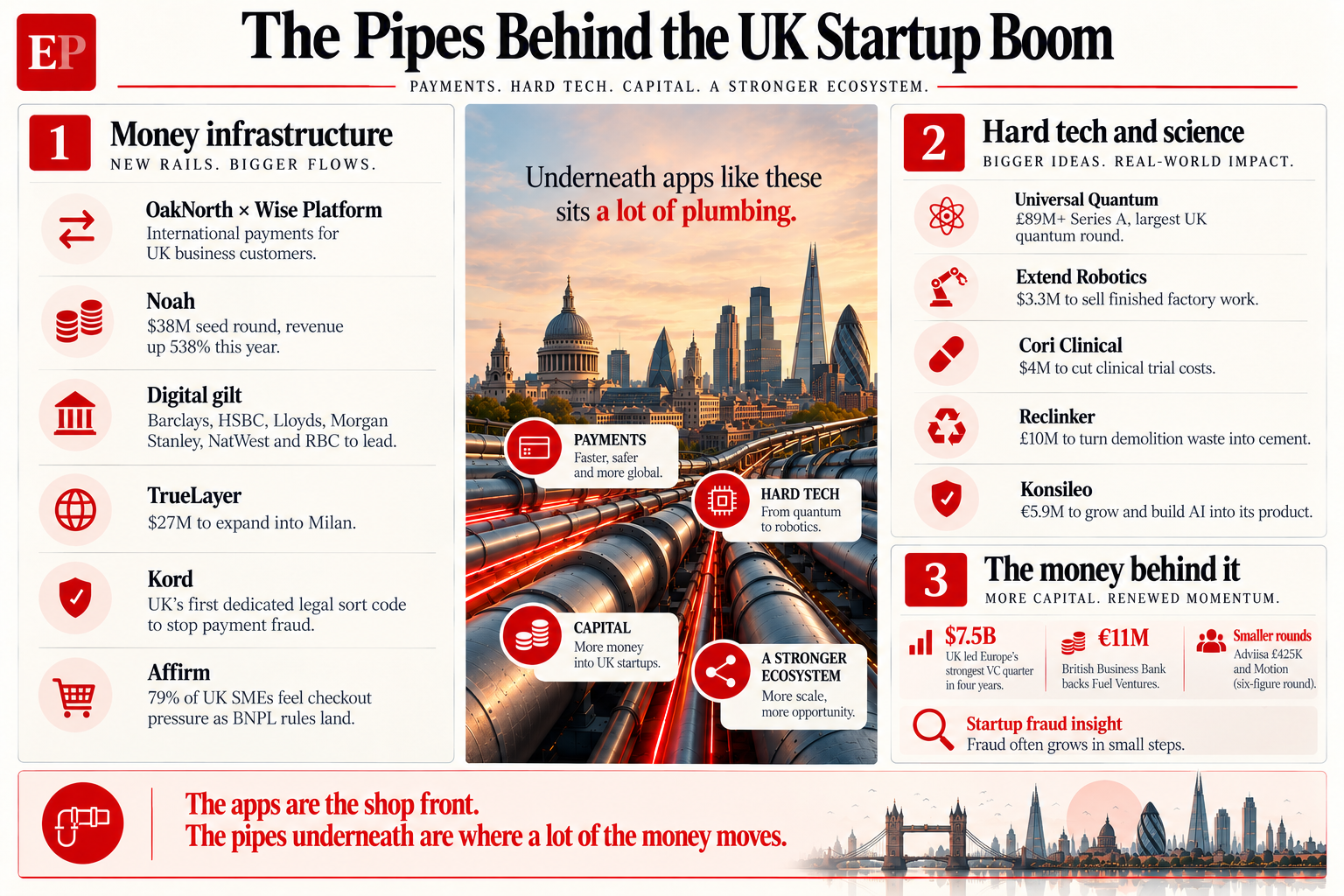
Money infrastructure
→ OakNorth picked Wise Platform to run international payments for its UK business customers, and Wise wants that infrastructure arm to reach 10% of its cross-border volumes.
→ Noah, the London stablecoin payments company, closed its seed round at $38 million after a $16 million top-up, with revenue up 538% this year and a New York office on the way.
→ The Treasury named Barclays, HSBC, Lloyds, Morgan Stanley, NatWest and RBC as lead managers for DIGIT, Britain’s first digital gilt, due by early 2027 on HSBC’s platform.
→ TrueLayer raised $27 million, led by CDP Venture Capital, as it expands into Milan.
→ Kord launched what it says is the UK’s first dedicated legal sort code, aimed at stopping Friday-afternoon payment fraud.
→ An Affirm survey found 79% of UK SMEs feel checkout pressure as buy now pay later rules land.
Hard tech and science
→ Universal Quantum raised more than $100 million (€89 million) in the largest Series A ever by a UK quantum company, co-led by DCVC and Firgun Ventures.
→ Extend Robotics raised $3.3 million to sell finished factory work instead of robots.
→ Cori Clinical raised $4 million to cut the cost of changes to clinical trial protocols.
→ Cambridge’s Reclinker raised £10 million to turn demolition waste into new cement.
→ Insurtech Konsileo raised €5.9 million to grow its team and build AI into its product.
The money behind it
→ Europe had its strongest venture quarter in four years, and the UK led it with $7.5 billion, according to Crunchbase.
→ The British Business Bank put €11 million into the multi-fund VC firm Fuel Ventures.
→ Imperial College and Emlyon researchers found startup fraud usually grows through small steps, and that investors often keep backing founders who’ve been accused of it.
→ Smaller rounds: Cambridge’s Adviisa raised £425,000 and named Russell Gould as founding CEO, and care-tech startup Motion landed a six-figure impact round to grow in the UK.
Freetrade’s biggest earner is currency conversion, and Wise is building a whole business out of selling that kind of rail to banks. The apps are the shop front, and the pipes underneath are where a lot of the money actually moves.
One pattern we noticed
The free part is rarely where the money usually is.
Chip earns on the 45p. Freetrade earns on the currency fee.
Trading 212 earns on the spread, the lending and the cash you leave behind.
Underneath them, Wise, Noah and the Treasury’s digital gilt are all building the rails that money moves on.
The part you see is free, or close to it. The part that earns is the layer you don’t.
One number
£18.5 million - what Freetrade earned from currency conversion fees in its 2025 financial year, more than two and a half times its £6.8 million from subscriptions.
Question of the week
Be honest: when did you last read the fee page of an app you call free?
Email us at [email protected] and tell us because we read every single answer, and yours might end up in next week’s brief.
Sources: Chip, Freetrade and Trading 212 figures from EP+’s own reporting, drawing on Companies House filings, IG Group announcements and each company’s published fees. Universal Quantum figures from EU-Startups, Electronics Weekly and Business Cloud. Noah figures from Tech.eu and GlobeNewswire. Wise and OakNorth from City AM and Wise’s press release. DIGIT from HM Treasury announcements via The Paypers and Finadium. Palantir NHS timeline from AFP and CGTN. Europe Q3 funding from Crunchbase, via Silicon Republic. Imperial and Emlyon study from Grit Daily and Technology.org.


