

Three companies take a cut of the same pot of savings, and each one gets paid at a different moment.
Imagine you have £20,000 and you want it invested.
The first door says it costs nothing.
So that is InvestEngine, which charges no platform fee on its DIY portfolios. It started out as a robo-advice product, and its co-founder has said the free version was built to solve the high cost of winning customers. So how does it earn? Mostly from the interest on cash you haven’t invested yet, which stays with the platform, plus a 0.25% fee on managed portfolios and partnerships with ETF providers.
The second door shows you the price on the way in.
Now, that is Moneyfarm, and on £20,000 it comes to 0.70% a year, 0.45% for management and 0.25% for the platform. Add fund costs and it can reach 0.91%. On our arithmetic that is about £140 a year before fund costs, and it rises as your pot grows.
The third door is the one you will never walk through, and that is FNZ, it runs the technology and operations behind more than 650 banks, insurers, and wealth managers, and it earns recurring fees linked to the assets on its platform, which now holds US$2.5 trillion.
Yet you never see its name, but some of your savings may well sit on its plumbing.
These three look nothing alike, but they do have one thing in common, each earns while your money stays in one place.
The difference is when each one is paid.
InvestEngine earns on the cash you haven’t put to work yet, while Moneyfarm and FNZ earn more as the assets grow.
So,“which is the cheapest?” is probably the first wrong question, and we think, “when does each one get paid?” tells you a lot more.
There is one more difference.
FNZ is the biggest by far, yet two published figures for its 2025 revenue differ by more than US$500 million, because they appear to measure different things.
So how much of US$2.5 trillion becomes profit? Our FNZ piece sets out what the public record can and cannot tell us.
Read the full breakdowns of How FNZ Makes Money, How InvestEngine Makes Money and How Moneyfarm Makes Money.
Also on EP+ this week:
→ He built Zoopla without owning a single home, then started a company that owned the cars it sold: Why Did Alex Chesterman, Zoopla’s Founder, Start Buying Cars?
→ Taavet Hinrikus sold down his Wise shares and left the chair, then wrote to shareholders about its US move: Taavet Hinrikus and Wise’s Unfinished Business
→ Councils spend 34% of their budgets directly with small suppliers, central government spends 10%: Is UK Government Procurement Now Competing With Its Own Suppliers?
→ Selling your company? Who carries the risk after completion can be insured: What Is Warranty & Indemnity (W&I) Insurance in a UK Startup Sale?
The wider ecosystem: what is everyone waiting for?
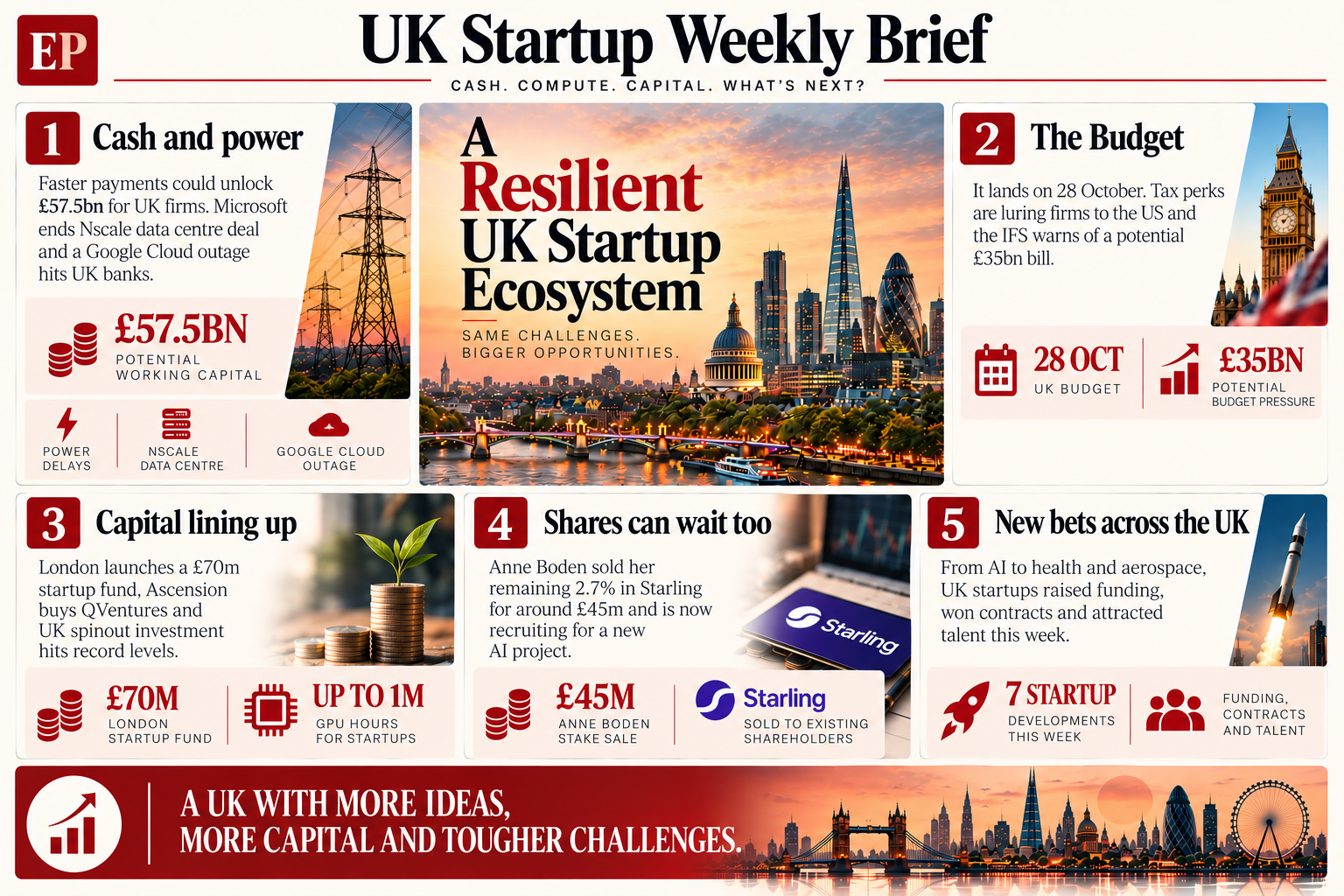
Cash and power
Navro says faster payments could unlock £57.5 billion for UK firms, which is working capital sitting in slow payment systems.
The Telegraph reported that Microsoft has ended its agreement for Nscale’s planned Loughton data centre in Essex, after grid operators reportedly said power would not arrive until the 2030s.
Nscale says it remains committed to the site, is exploring other power sources and that its relationship with Microsoft remains strong.
FinTech News Switzerland also reports a Google Cloud outage affecting UK banks.
The Budget
It lands on 28th October, and the warnings are already loud. Bloomberg reports that tax perks are luring Britain’s fastest-growing firms to America, the IFS says rampant inflation could land the Chancellor with a £35 billion bill, and Forex Factory lists five ways the Budget could shock.
Capital lining up
City AM reports London has launched a £70 million fund for startups struggling to raise investment, and Ascension has acquired QVentures to unite UK early-stage funds backing more than 250 startups.
FF News says UK spinout investment is at near-record levels, and EU-Startups asks whether the UK is leading Europe’s startup funding race (yes, with a catch). Sovereign AI is also offering UK startups up to 1 million free GPU hours for research.
Shares can wait too
Anne Boden, who founded Starling in 2014, has sold her last 2.7% at an implied £1.7 billion valuation, around £45 million, according to Sky News. Starling says the shares went privately to existing shareholders with its full knowledge, and the bank was reportedly seeking up to £4 billion in a secondary sale last year. City AM reports Boden is now recruiting for a new AI project.
And plenty of people did not wait.
Thore Graepel, co-creator of AlphaGo, launched Metis Reasoning in London and is reportedly raising tens of millions of dollars for a compute-efficient approach to AI.
Unravel Health raised €2.96 million for a palm-sized home lab to track hormones, XRlabs raised €7.48 million to bring AI into the operating room, and Skyfly raised €8.91 million for its two-seat eVTOL and a defence version.
Bristol’s Siloton won a €9.98 million Innovate UK contract for handheld eye imaging, CoComply raised £1.9 million from Mercia and Haatch to expose hidden contractors, and Emerald raised 1.66m for preventive healthcare.
BusinessCloud asks why UK startups cannot hire their way out of the cyber skills shortage.
One pattern we noticed
Whenever money waits, someone is usually earning from the wait.
InvestEngine, Moneyfarm and FNZ each found a way to be paid while savings sit on a platform.
That same shape ran through the rest of the week: £57.5 billion waiting in slow payments, a data centre waiting for power, a Budget everyone is waiting on, and a founder’s shares that waited twelve years for a buyer.
Waiting is not always a problem, but someone usually pays for it, and it is not always the person doing the waiting.
One number
US$2.5 trillion: the client assets on FNZ’s platform, according to FNZ in September 2026.
Question of the week
Do you know how the app or account that holds your savings makes its money?
Email us at [email protected] and tell us. We read every single answer, and yours might end up in next week’s brief.
Sources: EP+’s own reporting (FNZ, InvestEngine, Moneyfarm, Alex Chesterman, Taavet Hinrikus, UK government procurement, W&I insurance); Sky News, City AM and Briefs (Starling); Telegraph via Reuters, BBC and Techenclave (Nscale and Microsoft); Tech.eu (Metis Reasoning); Bloomberg, Forex Factory and City AM (Budget); FinTech Global (Navro); Dealroom (Ascension and QVentures, Emerald); FF News (spinouts); EU-Startups (Unravel Health, XRlabs, Skyfly, Siloton, funding race); Tech Funding News (CoComply); EdTech Innovation Hub (Sovereign AI); BusinessCloud (cyber skills); FinTech News Switzerland (Google Cloud outage).


