

A startup can attract millions in funding, build a product people use or secure a place in a major industry. But what actually makes the business work?
This week, EP+ explored that question from several angles: how platforms such as Skyscanner, Griffin and Zoopla make money, whether railway pilots can become commercial orders; who really buys emerging water technology, and what happens when the traditional route to an exit becomes harder to access.
Across the wider UK ecosystem, fresh investment in AI and semiconductor startups adds another dimension to the same conversation: where capital is going and what it expects in return.
From business models and procurement to funding and exits, this week's stories look beyond the headline milestone to examine the mechanics of building and sustaining a company.
Also on EP+ this week:
→ What Wise, Nscale and Monzo Reveal About the UK Tech IPO Drought — What is keeping UK technology companies from going public, and what do three very different businesses reveal about the state of the IPO market?
→ How Does Skyscanner Make Money? Inside Its Commission Model — The travel platform helps millions compare flights, but how does it generate revenue when customers often complete bookings elsewhere?
→ What Is a Management Buyout? Could It Work for a UK Startup? — With public listings and traditional exits presenting challenges, could management buyouts offer founders another route?
→ Will Great British Railways Turn Startup Pilots Into Orders? — The railway has been testing new technologies, but can startups turn successful pilots into actual procurement contracts?
→ How Does Griffin Make Money? A Bank Fintechs Build On — We examine the infrastructure-led banking model and how Griffin generates revenue by providing services to other fintech businesses.
→ What Satellite Leak Detection Reveals About Who Really Buys UK Water Tech — Satellite technology can identify potential leaks, but who pays for these solutions, and what does it take to get them adopted?
→ Why Martha Lane Fox Walked Away From lastminute.com — From building lastminute.com to shaping the UK's digital public services and now examining AI's impact on jobs, we trace the problems Baroness Lane Fox has chosen to tackle.
→ How Does Zoopla Make Money? Inside the Property Portal's Business Model — Behind the free property searches is a business built around estate agents, housebuilders, advertising and subscription products. We unpack its revenue model.
Across the UK startup ecosystem:
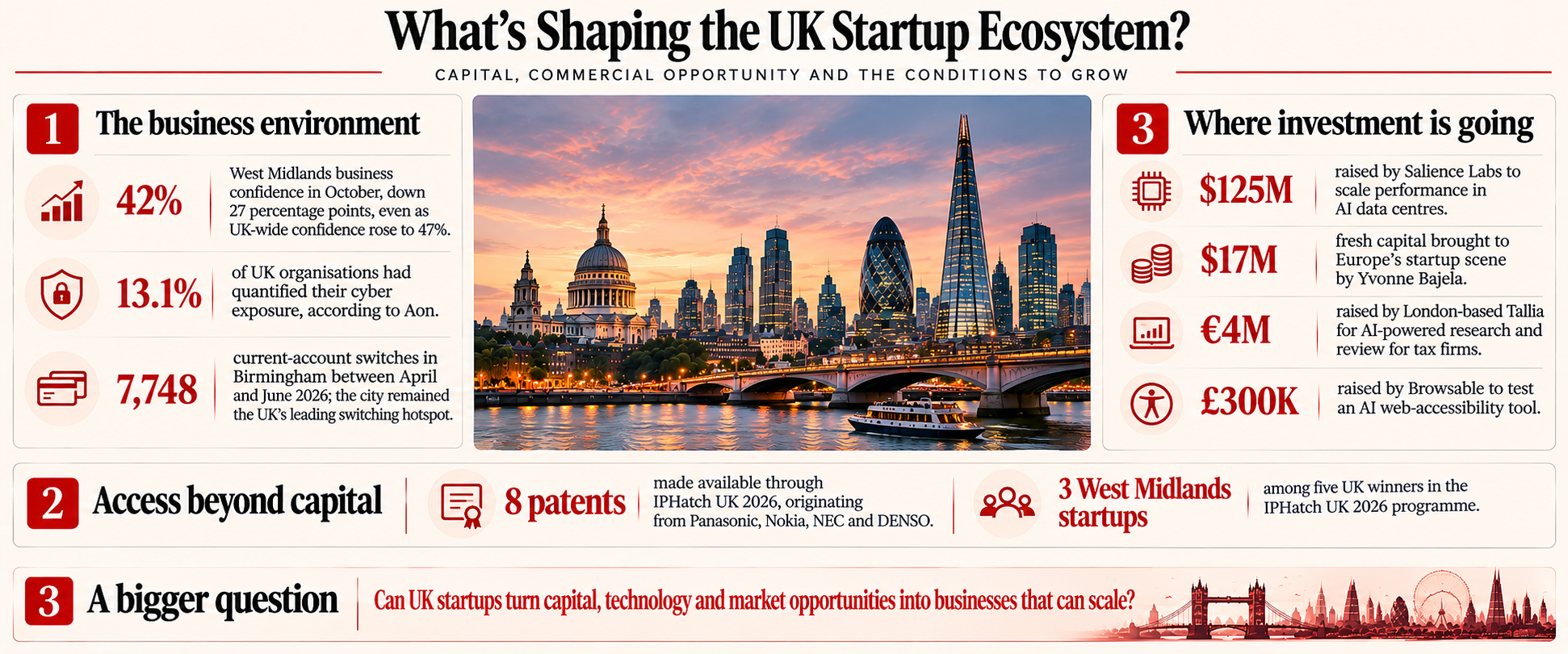
→ West Midlands Startups Win Patents From Tech Giants — Three West Midlands startups are among five UK winners of IPHatch UK 2026, gaining access to eight patents originating from Panasonic, Nokia, NEC and DENSO. The programme offers smaller businesses a route to technology and intellectual property that could otherwise be difficult to access.
→ Few UK Firms Quantify Their Disruption Risk, Aon Finds — Cyber incidents, supply-chain disruption and business interruption are converging, but preparedness remains limited. Aon found that only 13.1% of UK organisations had quantified their cyber exposure, highlighting a significant resilience gap for businesses.
→ West Midlands Business Confidence Falls Sharply as UK Picture Improves — Regional business confidence dropped 27 points to 42% in October, even as UK-wide confidence rose to 47%. The figures offer a contrasting picture of the conditions facing businesses across the country.
→ Birmingham Stays the UK's Current Account Switching Capital — Birmingham recorded 7,748 current-account switches between April and June 2026, retaining its position as the country's leading switching hotspot for a second consecutive quarter.
→ Yvonne Bajela Brings $17 Million in Fresh Capital to Europe's Startup Scene — Fresh capital is entering the European early-stage investment landscape, adding to the pool of funding available to ambitious founders.
→ Salience Labs Raises $125 Million to Scale AI Data-Centre Performance — The UK semiconductor startup is targeting the performance demands of AI data centres, highlighting the investment flowing into the infrastructure behind the AI boom.
→ Tallia Raises €4 Million for AI-Powered Research and Review for Tax Firms — The London-based company is applying AI to a specialised professional-services workflow, bringing automation into tax research and review.
→ Browsable Raises £300,000 to Test an AI Web Accessibility Tool — The funding will help the startup test an AI-powered approach to improving web accessibility.
One pattern we noticed
Across this week's coverage, the same distinction keeps appearing: having an opportunity is not the same as being able to capitalise on it.
A pilot is not a contract. A large valuation is not an IPO. A widely used platform still needs a revenue model. Access to a patent does not automatically create a commercial product, and investment in technology does not guarantee that businesses are prepared to adopt it.
The UK startup ecosystem has no shortage of ideas, capital or ambition. The harder test is whether companies can access the customers, infrastructure, expertise and commercial opportunities needed to turn them into sustainable businesses.
One number
600,000.
That is the approximate number of Londoners identified by the London AI and Jobs Taskforce as being in occupations with higher AI exposure and a lower capacity to adapt.
The figure puts a human consequence behind the AI investment story and raises a question about who benefits from the technology being built.
Question of the week
The UK startup ecosystem is finding new ways to build, fund and commercialise technology, but which is the bigger obstacle to scaling a company in Britain today: access to capital, access to customers, or the infrastructure and conditions needed to grow?
Email us at [email protected] and tell us, because we read every single answer, and yours might just end up in next week’s brief.
Sources: EP+ editorial research and reporting; BusinessCloud, Insurance Business, TheBusinessDesk, The Fintech Times, TechCrunch, Evertiq, EU-Startups and Dealroom. Figures and developments are drawn from the respective company announcements, industry reports and publications.


