

A cargo bike courier in Oxford closed its doors in January. A pioneering green delivery firm in Cambridge went under months before that. Meanwhile, an EV charging network in the Midlands just had the best quarter of its life.
This is what a "green transport gold rush" actually looks like in 2026: real money, real infrastructure, and real casualties, all happening at once, in the same sector.
We think the honest story here is more interesting than the tidy one.
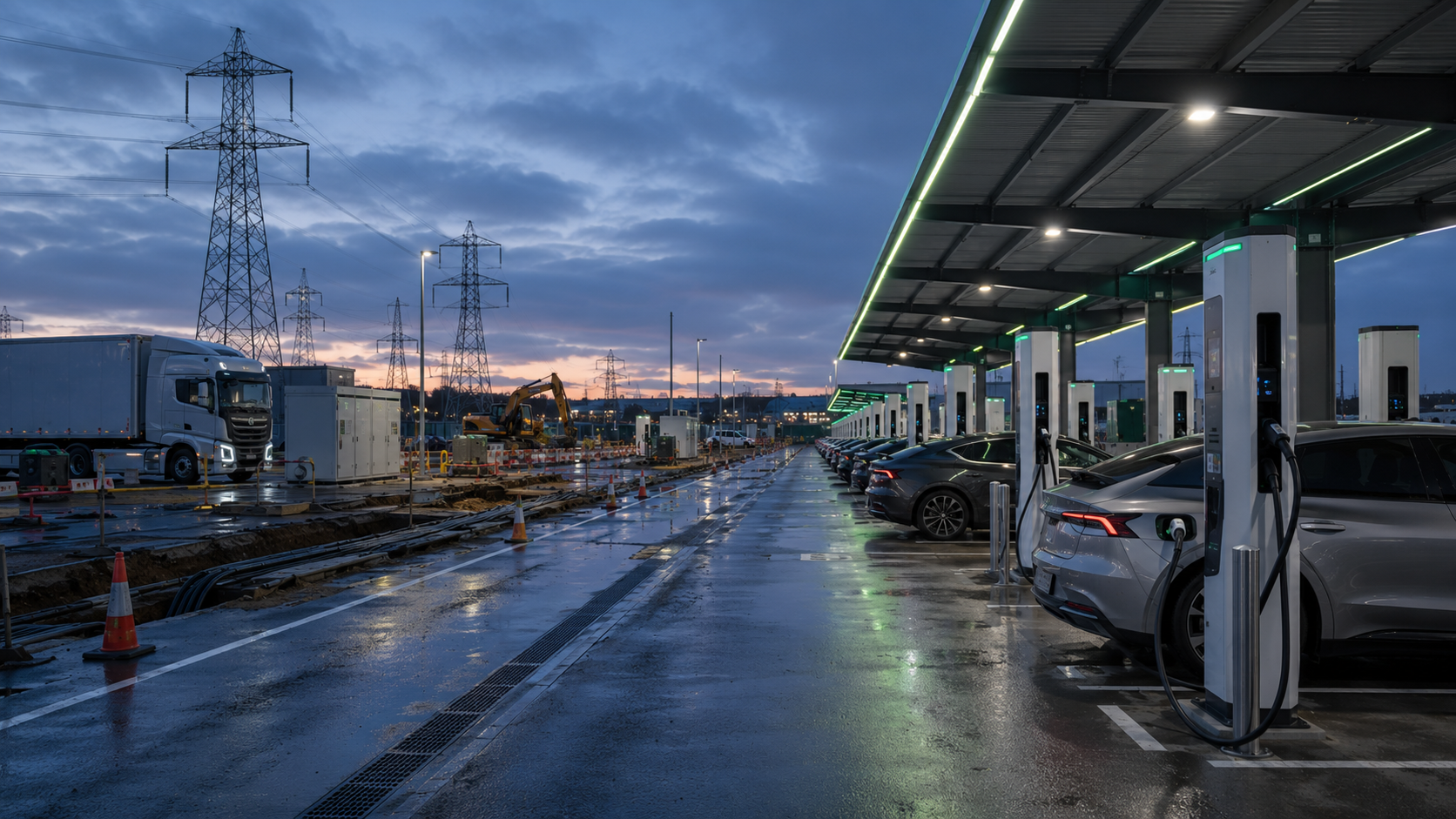
Britain's EV charging infrastructure now includes just over 116,000 public chargepoints, and the government wants that number to reach 300,000 by 2030. Now, if we do the math, there's a lot left to build in not very much time, and billions of pounds - from government and private investors alike - all riding on someone building it.
The chargepoint operators chasing that very gap are moving with real urgency.
Osprey Charging picked up an EV Driver Recommended award this year on the back of a fast-growing national EV charging network.GRIDSERVE, just had its strongest opening quarter on record, and its CEO recently opened the UK's first dedicated motorway charging hubs built specifically for electric lorries, suggesting freight could be the next major growth area. RAW Charging has been running free-charging promotions at its hubs, the kind of move a company makes when it's trying to win driver loyalty in a market that hasn't settled on its favourites yet.
Government support for electric vehicle charging is following the same urgency because a fresh billion pounds landed in March for fleet and depot charging, and the grant that helps businesses install workplace chargers just got more generous, but the scheme's own administrators have confirmed this is its final year.
For businesses considering new EV charging infrastructure installations, this may be a better time to act than to delay.
Three things standing in the way
If you're building an EV charging infrastructure startup right now, there is real money available. So, are three headaches that keep coming up in finance conversations.
The grid is the first. Getting a new site properly connected can take well over a year in many parts of the country, which is honestly a bottleneck that no amount of capital can simply buy its way past.
Tax comes in second. Charge your car in public, and you pay 20% VAT versus 5% at home, which is a gap that's actually now before the courts. A tribunal ruled this year that public charging should qualify for the lower rate too, but HMRC is appealing, so the 20% rate still stands for now. Either way, this has been a real issue for the sector.
Finally, there's the politics. The government's electric vehicle sales targets are facing growing pressure to be relaxed, and industry leaders warn that doing so could cut future investment in charging infrastructure by almost half. For an EV charging infrastructure sector built on long-term investment, it's the uncertainty that's keeping people up at night.
The quiet success story of e-bikes
While electric vehicle charging grabs the headlines, e-bikes have had a genuinely strong year without needing a single new law to help them along, and they're already legal on UK roads, which is more than can be said for their scooter cousins.
Volt Bikes, a UK-built manufacturer, launched a new city e-bike in May with a gear system designed to do away with manual gear changes altogether - a small British engineering win that picked up a design award before the bike had even reached customers.
There's no major government grant scheme behind e-bikes in the way there is for EVs, most of the support comes from councils and cycling charities, yet the market has continued to grow quietly.
Still waiting for e-scooters?
Here's the plain and simple truth: private e-scooters are still illegal to ride on UK public roads.
A bill that would change that has been sitting in Parliament since February. The only legal way to ride one - a rental trial - has now been extended for the fifth time, and won't wrap up until 2028.
Operators have been waiting since 2020, and they're still waiting. Without a clear legal framework, it's difficult for the sector to move forward.
Logistics: where the casualties are the story
On paper, last-mile delivery by cargo bike looks like an obvious opportunity - the same rules pushing vans towards electric should be creating demand for exactly this kind of service.
Whereas in practice, it's been a brutal stretch.
Zedify, once one of the most recognisable names in cargo bike delivery, went into administration in early 2025 after it couldn't raise the funding to keep going. It's since found a buyer for parts of the business, but most of its hubs closed, and over a hundred jobs went in the process. Pedal & Post, a business that had been trading in Oxford and London for over a decade, collapsed into liquidation in January after a single client contract - worth a quarter of its revenue - disappeared overnight.
Sixty people lost their jobs.
Pedal Me is the one still standing, taking on former Zedify staff and speaking candidly about a challenging year of restructuring before returning to growth.
We don't think that means the opportunity here is fake, we think it means two well-known operators leaned too hard on too few clients, and whoever builds the next one will need a sturdier foundation than either of them had.
Where this leaves us all
The EV charging network has the capital and the infrastructure gap pointing in the same direction - real momentum, real risk. E-bikes are succeeding quietly, without fuss, e-scooters are exactly where they were six years ago, and logistics electrification has already claimed its first casualties before most people even clocked it as a sector worth watching.
We don't think that adds up to a gold rush, we think it adds up to a market working out, in real time, who actually has a business and who just got there early.
Editorial Note: This piece is based on secondary research - public reporting, company announcements, and industry data - rather than direct interviews with Osprey, GRIDSERVE, RAW Charging, Volt Bikes, or Pedal Me. If you're building in this space and want to talk to us, we'd love to hear from you.
Also read: The UK Quietly Became Climate Tech's Bright Spot
Sources: GOV.UK — Electric vehicle public charging infrastructure statistics, January and April 2026 · GOV.UK — Electric vehicle charging device grant scheme statistics, January 2026 · EV Infrastructure News — UK EV charging reforms and Workplace Charging Scheme grant increase (April 2026) · Zapmap — UK EV charger network data, May 2026 · Zapmap — EV charging VAT: the public vs home tax gap explained · vatcalc.com — UK Tribunal ruling and HMRC appeal on public charging VAT (April 2026) · electrive.com — UK tax authority to appeal EV charging VAT ruling (April 2026) · Cycling Industry News — Zedify administration and Pedal Me's response (February 2025) · Motor Transport — Zedify collapse coverage (February 2025) · Zag Daily — Pedal & Post ceases all operations (January 2026) · Preston Blog — Pedal & Post collapse and Voi contract loss (2026)


