


The UK Global Talent Visa has quietly become one of the most attractive unsponsored founder visas available to tech founders looking to build in Britain.
No employer sponsorship.
No job offer required.
No salary threshold.
No annual cap.
For founders building in AI or cybersecurity, there is now a fast-track endorsement process that moves in as little as three weeks.
But the Global Talent Visa UK is significantly harder to obtain than most guides suggest. The headline approval rate looks reassuring. The real picture is more complicated. And the mistakes that cause rejections are almost always the same ones and almost always avoidable.
This is what you actually need to know.
What the Global Talent Visa Is – and Why It Matters for Founders
The Global Talent Visa is the UK's primary unsponsored work visa for exceptional individuals in digital technology, science, research, and the arts.
For tech founders specifically, it offers something the Skilled Worker visa cannot:
the freedom to run your own company,
work across multiple projects,
pivot your business,
and build in the UK without being tied to an employer or a business plan.
The visa replaced the old Tier 1 (Exceptional Talent) route in February 2020. It comes in two forms:
Exceptional Talent – for recognised leaders with a proven track record.
Exceptional Promise – for emerging leaders earlier in their career.
Both carry the same working rights.
The difference is how quickly you can apply for Indefinite Leave to Remain. Exceptional Talent gets you there in three years. Exceptional Promise takes five.
For most tech founders working in digital technology, the route runs through Tech Nation - the designated endorsing body for digital technology, whose contract with the Home Office was renewed in May 2025 and runs through to at least 2028.
Global Talent Visa vs Innovator Founder Visa: Which One Is Right for You?
Both visas allow tech founders to build companies in the UK. But they are designed for fundamentally different profiles.
The Global Talent Visa looks backwards. It rewards what you have already built, shipped, and been recognised for.
The Innovator Founder Visa looks forwards. It assesses the business idea you are bringing to the UK. You need an endorsing body to approve your concept as innovative, viable, and scalable - and you face monitoring check-ins and restrictions on third-party work once here.
In practice:
- Apply for the Global Talent Visa UK if you have a strong portfolio and external recognition.
- Apply for the Innovator Founder Visa if you are a first-time founder with a compelling concept but limited professional accolades.
The Global Talent Visa is the stronger long-term option for most experienced founders but only if the evidence is genuinely there.
The Visa Is Easy. The Endorsement Is the Real Test.
Most articles quote an overall visa success rate that makes the Global Talent route sound almost guaranteed. That figure is technically accurate but it is also deeply misleading.
The Home Office approves approximately 99.2% of Global Talent Visa applications at the final visa stage. But that statistic only applies to applicants who have already secured endorsement. It does not include those rejected before they ever reach the visa stage.
The endorsement stage is where most applicants fail.
Between April 2020 and April 2023, the overall endorsement success rate across all fields was approximately 72%. But that figure masks significant variation by field.
For digital technology applicants, the global talent visa approval rate has historically been reported in the 54–65% range. Roughly one in three applicants may be refused before they ever submit a visa application.
By comparison, endorsement routes for researchers and academics through bodies including the Royal Society, the Royal Academy of Engineering, and the British Academy have historically recorded significantly higher approval rates, often around 90%.
For most technology founders and operators, the biggest challenge is not obtaining the UK work visa itself. It is securing the Tech Nation endorsement.
Note: The Home Office does not currently publish field-specific endorsement success rates for 2025–2026. The figures above reflect the most recent publicly available data from the Home Office's own evaluation covering April 2020 - April 2023.
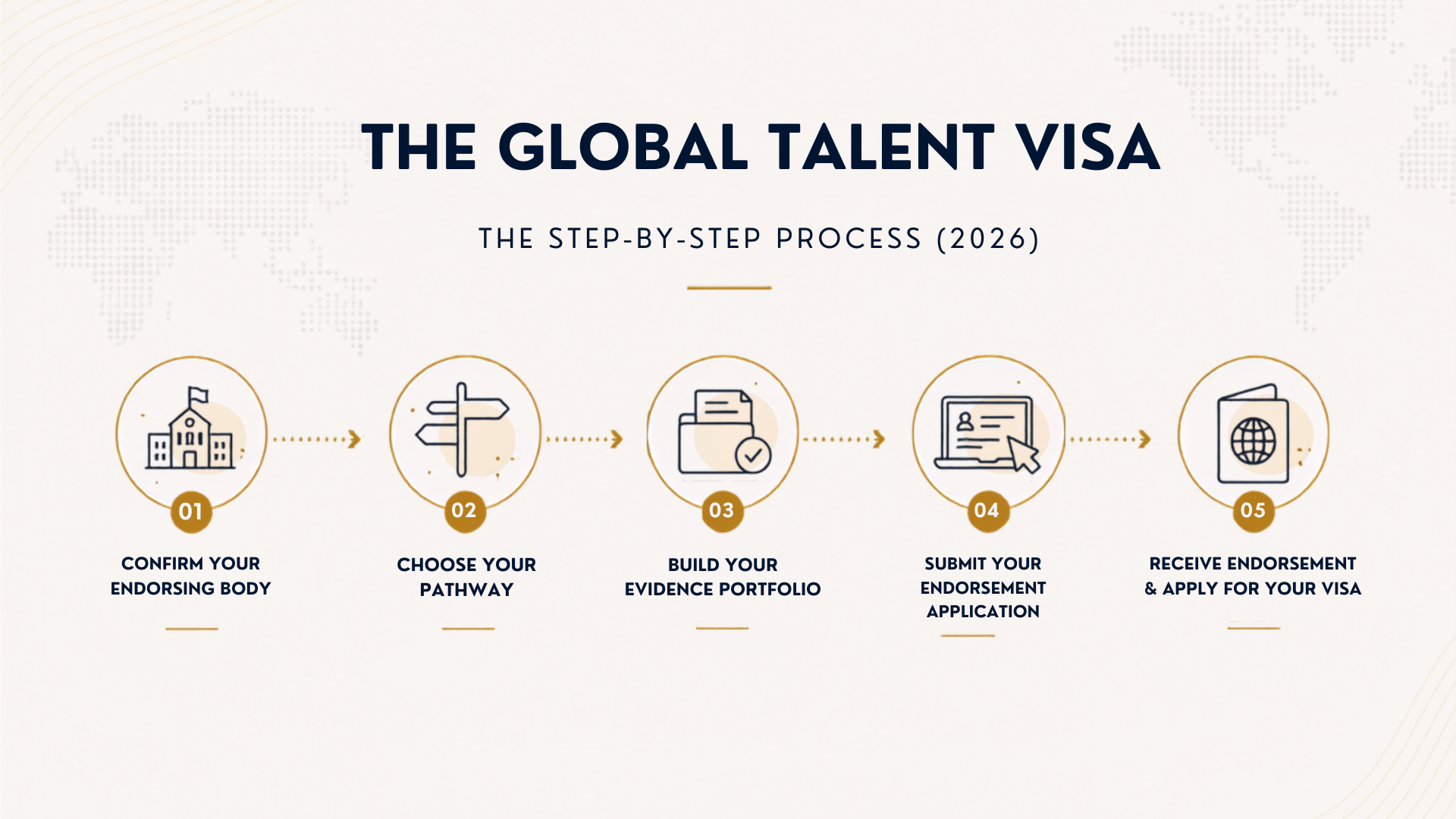
The Step-by-Step Process
Step 1: Confirm your endorsing body
For digital technology founders, that is Tech Nation.
One important update: since 4 August 2025, Tech Nation's own application portal has been permanently withdrawn. All applications now go through the standard Home Office Stage 1 form on GOV.UK. Several guides still reference the old Tech Nation portal - ignore them.
If your work sits across boundaries for example, biotech with a strong digital component checks whether Tech Nation or a science body is the better fit before applying.
Step 2: Choose your pathway
Exceptional Talent or Exceptional Promise.
This is not purely about career stage, it is about evidence strength. If you have less than five years of experience, Exceptional Promise is the only option available. But if you are more senior and your evidence is stronger under one pathway than the other, apply accordingly.
The choice has real consequences: UK work visa settlement in three years versus five.
Step 3: Build your evidence portfolio
Tech Nation assesses applications against mandatory and optional criteria. For founders, the evidence that carries the most weight includes:
- proof of being a founder or senior executive of a product-led digital technology company,
- commercial traction - revenue, user numbers, investment raised,
- external recognition press coverage, awards, industry citations,
- patents or published research with third-party validation,
- speaking invitations, board positions, or advisory roles that demonstrate standing beyond your own company.
One well-evidenced achievement is worth more than ten loosely connected ones.
Step 4: Prepare your reference letters
You will need three referees. This is where founder applications most commonly fall apart.
Tech Nation is explicit: referees must come from tech product-led businesses or leading tech companies. Referees from banks, consulting firms, or non-product businesses are a common and direct cause of rejection.
Brief your referees carefully. Give them the specific criteria Tech Nation uses. Ask them to speak to measurable impact, not just professional admiration.
Step 5: Submit and wait
The endorsement fee is £561, paid at Stage 1. Processing typically takes five to eight weeks. For founders working in AI or cybersecurity, an expedited three-week timeline was introduced in 2025.
Once endorsed, you have three months to submit your UK work visa application.
Step 6: Apply for the visa
The visa application fee is £205, paid at Stage 2. The total Home Office fee across both stages is £766.
Each dependant - partner or child - pays a separate £766.
The Immigration Health Surcharge is £1,035 per person per year, paid upfront for the full duration of leave requested.
For a five-year visa for a solo applicant, the total all-in government cost is approximately £5,941.
If you hold a qualifying prestigious prize, a Turing Award, for example you can bypass Tech Nation endorsement entirely and move straight to the visa stage, paying £766 in one go.
The Three Rejection Reasons Most Founders Don't See Coming
1. Financials without context
Founders frequently submit business documents, revenue figures, accounts, cap table without explicitly connecting them to digital technology leadership. Tech Nation does not interpret financial records in isolation. Without clear evidence of commercial traction and external validation, they add little weight.
2. The wrong referees
Referees from professional services, banking, or consulting however seniors are routinely noted as a reason for refusal. The signal Tech Nation looks for is recognition from within the product-led tech ecosystem specifically.
3. Internal recognition only
Applications that rely on internal promotion records, internal awards, or in-house project documentation without corresponding external recognition consistently fail to meet the broader field recognition Tech Nation requires.
If You Are Refused
Most guides do not mention this.
If your endorsement is refused, you have 28 days to request a free review.
No new evidence can be submitted the review examines whether your original application was properly assessed. You can only request one review per refusal decision.
If the review is unsuccessful, you can reapply from scratch once you have understood and addressed the gaps.
A refusal is not a permanent door closed.
The Bigger Picture
Tech Nation's contract runs to at least 2028. The fast-track for AI and cybersecurity is live. And the route to ILR in three years - genuinely rare among developed-world immigration systems – remains intact.
The founders who treat this like a product launch building their evidence portfolio methodically, briefing referees properly, documenting external impact rigorously tend to clear it.
The ones who treat it like a formality generally do not.
All fees correct as of June 2026. Endorsement success rate figures cover April 2020–April 2023 (Home Office Global Talent Visa evaluation). Always verify current fees and requirements at GOV.UK before applying.


