

Walk the floor of any major logistics hub in the Midlands and you'll notice something. The humans are still there, picking, sorting, loading. The robots are there too, increasingly, but the UK's most interesting companies are not investing in the physical machinery. It's on what the machinery thinks. That's the story quietly shaping the UK robotics industry.
Global robotics funding hit $27.6 billion in 2025, more than double the year before. The dominant narrative is humanoid robots: Figure AI at a $39 billion valuation, Tesla's Optimus being deployed in its own factories, Chinese manufacturers racing to produce general-purpose bipedal machines at scale. It's a compelling story. It's also largely happening somewhere else.
What the UK robotics industry is building is quieter, more specific, and in some ways more durable. A cluster of companies in Cambridge, Edinburgh, London, and Lincoln are working on a different kind of robotics problem. Not "can we make a robot that walks?" but "can we make a robot that thinks well enough to be useful in a field, or a lab, or a recycling facility?"
Whether that bet pays off is the genuinely open question hanging over the UK robotics industry in 2026.
The Fields First
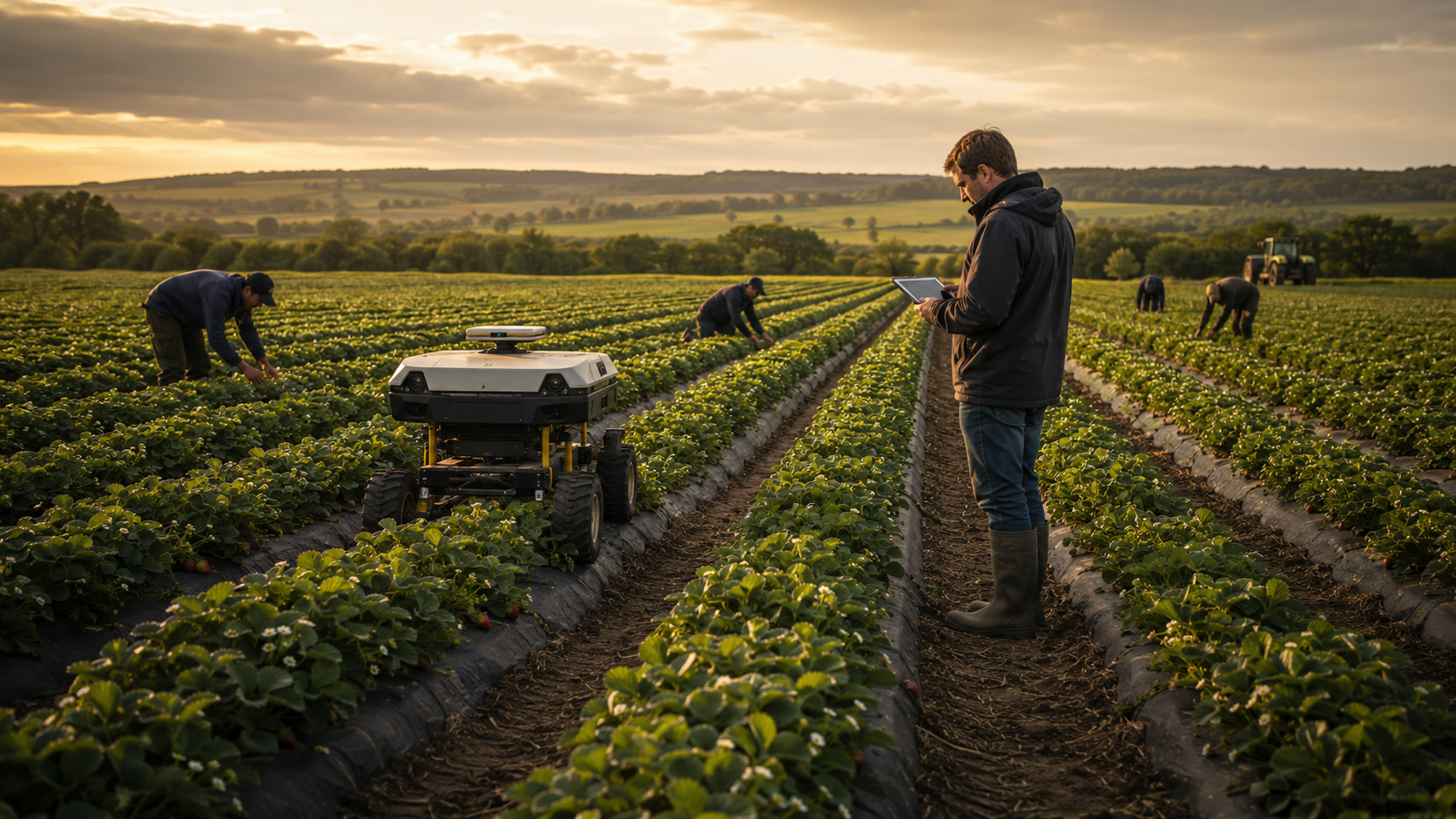
Ask most people to picture the UK robotics industry, and they'll imagine a warehouse The more interesting story is happening in Herefordshire, Kent, and Lincolnshire, and it starts with a labour problem that Brexit has made much harder to ignore.
Seasonal agricultural work in the UK depended heavily on EU workers. Post-Brexit, that supply thinned significantly. Farms couldn't find people to pick strawberries, thin fruit, or harvest soft crops. The economics of running a UK fruit farm began to look fragile.
That gap created a genuine commercial problem that robotics could plausibly solve, and a cluster of companies moved into it.
Dogtooth Technologies, based in Cambridge, has been building strawberry-picking robots since 2017, longer than most UK agri-robotics companies have existed. Antobot is developing autonomous systems for arable operations. Muddy Machines is working on robotic tools for asparagus harvesting. Earth Rover is building autonomous platforms for data collection on farms.
These aren't speculative university projects; they are companies with field trials running, agricultural partners signed, and some commercial deployments underway.
The government noticed that in April 2026, the UK committed £50 million in combined public and private investment specifically to accelerate deployment of robotics and AI tools for farmers – £8 million in government support alongside roughly £40 million from private investors.
A further £5 million early-stage fund was added for 2026-2027 to support agri-tech companies at earlier stages. The Farming Innovation Programme, delivered through Innovate UK, is putting real capital behind the sector.
Cambridge and Lincoln have become the two densest clusters, Cambridge draws from its autonomous vehicle and machine learning talent pool, with proximity to East Anglian arable land.
Lincoln Agri-Robotics at the University of Lincoln has become the most focused research hub in the country for field robotics.
The honest question is whether the commercial reality matches the research ambition.
One answer arrived in 2025, when Small Robot Company, one of the UK's most publicised agri-robotics startups, which had raised millions and appeared repeatedly in government innovation showcases, went into liquidation.
Hardware is expensive to develop and expensive to manufacture. Field conditions are unpredictable. Customer sales cycles in agriculture are long.
The gap between a compelling demo and a profitable deployed product will test many of these companies.
What's Actually Shipping
Zoom out from agri-robotics, and the hardware revenue picture gets a little clearer in other parts of the UK robotics industry.
Automata, a London-based startup, builds affordable robotic arms for laboratory automation. Its Eva robot arm and LINQ software platform are deployed across pharmaceutical and biotech labs in the UK and US. The customers are real, the deployments are operational, and the company sits in a specific market - lab automation for life sciences - where manual processes are genuinely painful and robotic alternatives truly save time and cost.
In Edinburgh, Xiaoyan Ma founded Danu Robotics after completing her MSc at the University of Edinburgh and exploring recycling efficiency in depth. She found a sector still largely dependent on manual sorting, expensive to operate and prone to contamination. Her H.E.R.O. series robotic systems are designed specifically for sorting dry mixed recyclables – modular and retrofittable into existing facilities, with computer vision systems that have driven contamination rates down from around 50% to below 1% in trials.
The company is small - nine people, around £1.5 million raised - but it shipped its first robots to development partners in January 2025, and Glasgow City Council's recycling centre is running a live trial. The EPR regulations coming into force in 2025 created new commercial urgency around recycling quality. The policy timing, for once, was helpful.
CMR Surgical sits at the larger end of the UK hardware story. Its Versius surgical robotics system, built specifically to be modular and moveable between theatres, unlike the dominant da Vinci surgical robot, has been deployed in NHS trusts and internationally. The company has raised over £1 billion. It's the clearest example of a UK robotics company that identified a specific institutional constraint (capital cost, lack of portability) and designed around it.
The Intelligence Bet
A common theme connects all of these, one that runs through the wider UK robotics industry. Automata's differentiation isn't the robot arm, it's the LINQ software that makes the arm useful across different lab workflows. Danu's edge isn't the gripper mechanism , it's the computer vision AI that identifies and sorts materials accurately. CMR's advantage over surgical robot incumbents is partly modularity, partly the AI-assisted guidance layer.
The UK government's own framing for the sector reflects this: the stated strategy is that AI software and data will be the highest-value layer of the robotics stack, and that the UK's depth in AI research - DeepMind, the university ecosystem, the VC concentration in London - can compensate for a relatively smaller manufacturing hardware base.
Whether that framing holds up is worth scrutinising. AI software as the differentiated layer is compelling in theory, but in practice, hardware still has to work reliably in unpredictable conditions, at scale, without breaking down.
That's a different engineering challenge from training a model, and it has caught UK companies out before.
What Comes Next
Innovate UK has opened a call for Robotics Adoption Hubs – regional centres specifically designed to help UK businesses understand and deploy robotics, with 40- 43-month project windows starting from September 2026.
The government has committed £4.3 billion to advanced manufacturing over five years - part of a broader push into manufacturing automation, including £2.8 billion directed at R&D in automation, robotics, and smart factories.
The infrastructure is being built, so the question is which companies will still be standing, with hardware in the field, customers paying, and unit economics that work, by the time the next funding cycle arrives. Agricultural robotics has the right policy environment and the right labour market conditions. Lab automation has real commercial deployments. Surgical robotics has one proven UK company operating at scale.
The humanoid race being run in California and Shenzhen is genuinely fascinating. The UK probably isn't winning it, and arguably isn't trying to. What the UK robotics industry might win instead is the narrower, harder, more commercially grounded contest to build robots that actually work in the specific environments where UK industries need them - a strawberry-picking robot in a Herefordshire field, a robot arm sorting recyclables in Edinburgh, a surgical robot in an NHS operating theatre.
Whether the intelligence-over-hardware bet turns out to be prescient or simply pragmatic, that's a question the next few years will answer.
Also Read: Definely Legaltech: How One Freshfields Lawyer Built a $40 Million Company
Sources: Innovate UK — Robotics Adoption Hubs open call (March 2026) · GOV.UK — £50M farming robotics investment (April 2026) · Robotics Jobs UK — Agricultural robotics sector overview (June 2026) · SVRC — European Robotics Market 2026, UK positioning (April 2026) · Tech Funding News — Global robotics funding $27.6B 2025 (May 2026) · Interface Online — Danu Robotics case study (2025) · Danu Robotics official website · Growth List — Global robotics funding data (March 2026) · Business.gov.uk — UK robotics and automation strategy · SquaredTech — UK H1 2026 startup funding (July 2026)


