

For decades, humanoid robots belonged in science fiction. Now one London startup has 25,000 preorders and customers lining up to put them to work. We went to find the catch.
Humanoid robots were the stars of films that belonged in futuristic cities and dystopian worlds, not exactly in warehouses outside Birmingham.
Yet, one London startup is betting that the gap between science fiction and a staff shortage is much smaller than we think.
The UK manufacturing sector currently has 48,000 unfilled vacancies.
Every empty shift costs a business somewhere between £25,000 and £40,000 a month in lost productivity.
The workers are not coming because of many reasons - demographics, immigration policy, and the simple fact that most people would rather do almost anything else have seen to that.
It is not a temporary shortage, it is a structural one.
That particular gap, which is so persistent, expensive, and politically invisible, IS the problem a London-based startup called Humanoid has decided to solve, not with a software tool, not with an app, but with a Humanoid Robot.
A Humanoid Robot, to be precise. One that walks, lifts, navigates warehouses, handles totes, and operates around the clock without a lunch break, a sick day, or a grudge.
We know how that sounds.
The graveyard of robotics companies that promised the future and delivered a costly piece of metal is long and well-documented.
So when Humanoid told us their HMND 01 had completed a live logistics trial at Siemens handling 60 totes per hour, that Schaeffler had committed to deploying hundreds of units across its factories, and that they had secured 25,000 preorders, we thought to ourselves, “What’s the catch?”
What we found after that was even more complicated than either the hype or the scepticism would suggest - particularly for a market increasingly shaped by Industrial AI, labour shortages, and the changing economics of Industrial automation UK.
Why a robot needs to look like a person
The first question worth answering is the obvious one: why DOES a robot need to look like a person?
The honest answer is that it doesn't - until you try to deploy it in an environment built for people.
Warehouses, factories, retail floors - these spaces are built around human dimensions.
The shelves are at human height.
The aisles are human-width.
The tools require human hands.
Purpose-built robots have dominated industrial automation for decades, but only within rigidly structured environments built specifically for them.
The moment you need flexibility, the ability to operate in spaces not designed with a robot in mind, the humanoid form stops being a philosophical choice and starts being a practical one.
That shift is increasingly relevant to warehouse robotics, where adaptability matters as much as raw throughput.
The timing matters too.
For years, the hardware existed, but the intelligence did not.
Robots could be built to move reliably. They could not be built to think reliably - to navigate an unstructured environment, respond to unexpected obstacles, understand a natural language instruction, or adapt when the real world did not match the model they had been trained on.
What changed is that the AI finally caught up with the body.
The convergence of generative AI and what the industry calls Vision-Language-Action models - the ability to perceive, reason, and act in real physical space - happened roughly in the last eighteen months.
Humanoid was building when it did.
“AI has unlocked our ability to apply algorithms to the physical world, changing everything for robots.” - Rev Lebaredian, Vice President of Omniverse, Nvidia
What is HMND 01
The HMND 01 is Humanoid's commercial platform - a modular Humanoid Robot powered by the company's proprietary AI framework, called KinetIQ.
It stands 175 centimetres tall, weighs 70 kilograms, walks at up to 1.5 metres per second, and can carry up to 33 kilograms. Battery life runs to approximately four hours - the honest limitation we will return to.
The modular design is the part we found genuinely fascinating.
Most robots are fixed
You buy the unit, and you get what you get.
The HMND 01 allows users to swap components depending on the task: a wheeled lower body for flat warehouse floors where speed matters and a bipedal configuration for more complex environments where stairs, ramps, or uneven surfaces come into play.
One AI brain, multiple physical configurations.
That is not how most of the competition works.
KinetIQ - the AI framework running beneath all of this - is a four-layer cognitive system that enables the robot to process visual information, understand natural-language instructions, plan actions, and execute them in real time.
In plain terms: you tell it what to do in ordinary English, and it works out how to do it without task-specific programming.
The Alpha Bipedal achieved stable walking within 48 hours of final assembly using simulation-trained AI policies rather than years of physical trial and error.
That development speed is the most telling detail in this story - it signals the maturity of the underlying technology and the accelerating role of Industrial AI inside physical systems.
The wheeled prototype was developed in seven months and the bipedal version in five.
Now that is what you call an impressive engineering timeline.
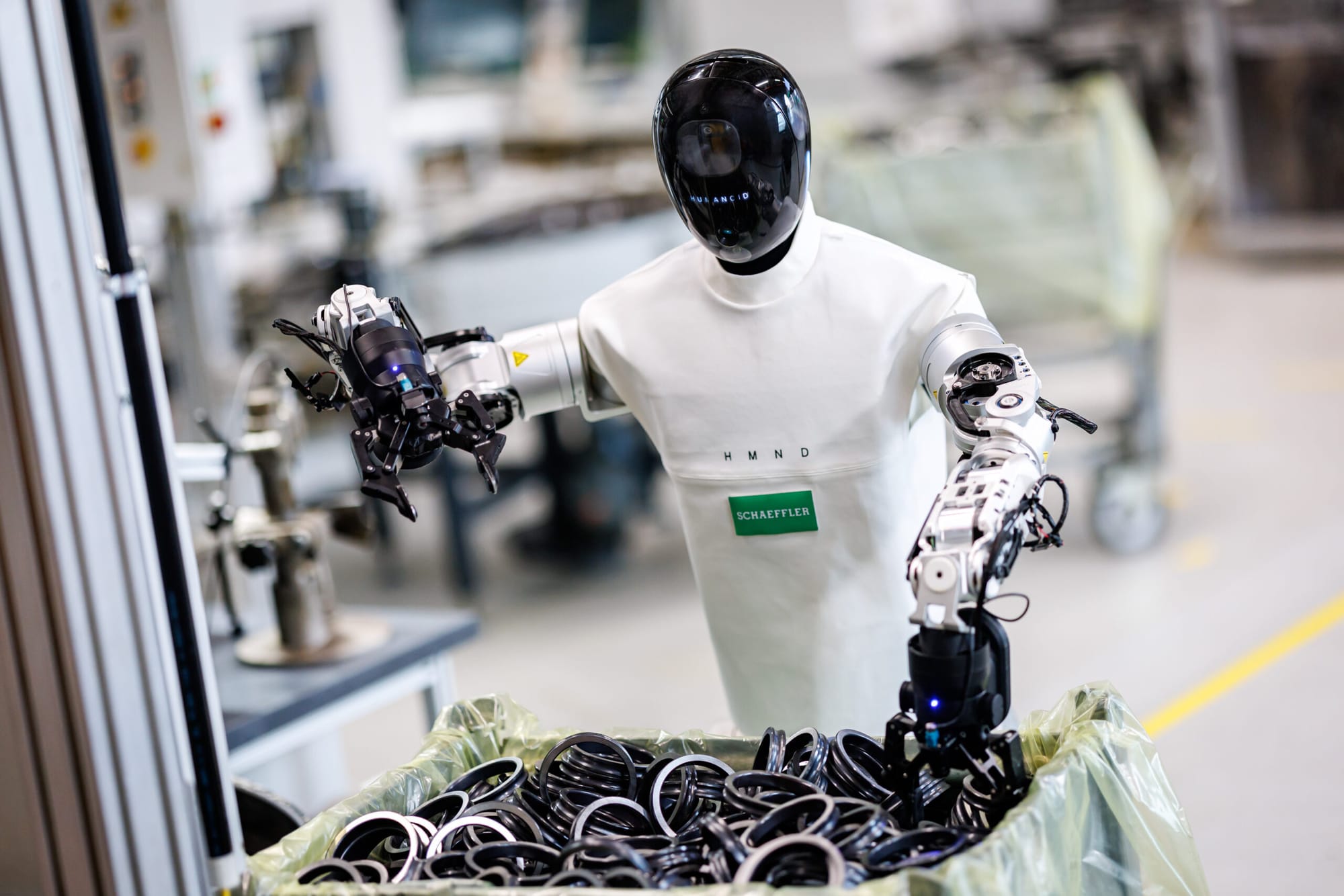
The Humanoid Robot market and why it is moving fast
The UK humanoid robot market was valued at $38.7 million in 2023, according to Grand View Research, and is projected to reach $110.8 million by 2030 at a 16.2% annual growth rate.
On the broader Physical AI model accounting for software and service layers on top of the hardware, more optimistic forecasts suggest the global market could grow at a compound annual rate of 95% through 2030.
Even the conservative numbers represent a market moving fast.
Humanoid is targeting three types of customers.
Large automotive and manufacturing OEMs Schaeffler, Siemens - who need precision, resilience, and 24/7 uptime.
Logistics and e-commerce fulfilment giants, where the problem is high-volume repetitive work, workforce churn, and the growing need for scalable warehouse robotics.
And SME precision engineering firms, who currently cannot access industrial automation at all because the upfront cost is prohibitive.
That third segment is strategically significant.
The reason most small manufacturers have not automated is not that they do not want to, but that the economics have never worked for them.
A Robotic- as-a-Service model monthly subscription rather than a six-figure capital outlay changes that equation.
Humanoid's recommended Robotics as a Service pricing sits between £4,000 and £6,000 per month, covering the robot, AI updates, insurance, and round-the-clock monitoring.
Against the fully-loaded cost of a UK warehouse worker at £30 to £45 per hour, the numbers on paper are compelling.
For advocates of Industrial automation UK, that pricing model may be one of the more important developments in years.
It potentially lowers the entry barrier not just for large corporations but for smaller manufacturers trying to modernise operations, adopt smart manufacturing, and remain competitive.
The competitive landscape
Humanoid is not the only company with this idea.
Figure AI, backed at a $39 billion valuation with Microsoft and Nvidia as partners, has already loaded 90,000 parts at BMW's Spartanburg plant.
Agility Robotics' Digit is the only humanoid currently generating revenue from productive commercial work.
Tesla's Optimus is targeting a $20,000–$30,000 price point that could commoditise the entire sector.
Unitree, a Chinese manufacturer, is already selling a full-featured bipedal robot for $13,500.
What Humanoid has that most of them don't is modularity and what the company describes as “sovereign trust.”
UK B2B buyers prioritise data residency, GDPR compliance, and domestic supply chains in a way that American and Chinese competitors cannot easily replicate.
A London-based company building to the world's toughest safety standards from the outset, positioned within the government's £52 million Robotics Adoption Hubs programme, and offering audit trails as a standard software feature - that is a meaningfully different proposition for government, defence, and critical infrastructure contracts.
We believe that regulatory positioning is a genuine competitive advantage.
In a market increasingly shaped by Industrial automation UK priorities, compliance, trust, and domestic capability matter more than they once did.
But it requires constant maintenance as regulations evolve, and it does nothing to address the cost gap against Unitree.
What worries us
It was the four-hour battery life that we kept returning to.
An industrial shift is typically eight to twelve hours.
A Humanoid Robot that needs recharging halfway through a shift is not a workforce solution but rather a workflow disruption.
The recommended fix would be autonomous battery-swap stations built into deployment packages.
That is the right answer, but it is not yet built.
There is also the question of physical hallucination - a robot taking an incorrect physical action in a live environment.
Unlike a chatbot giving a wrong answer, the consequences can include damaged equipment, injured workers, and regulatory investigations.
Humanoid's industrial-first strategy manages this risk sensibly.
It does not eliminate it.
And then there is the manufacturing scale.
Tesla is not a startup.
Unitree's $13,500 price point exists because of a supply-chain advantage that a London company cannot replicate quickly.
How Humanoid competes on cost as the market matures is a question we did not find a clean answer to.
That challenge becomes sharper as Industrial AI capabilities improve across the sector and lower-cost competitors continue to emerge.
The economics of robotics are not determined by software alone.
They are determined by manufacturing discipline, component sourcing, and the brutal realities of industrial scale.
Keeping an eye on
In 2026, Humanoid Robot technology stopped being a science fiction prop and started being a line item on a factory floor spreadsheet. That transition is genuinely significant, and Humanoid is one of the more credible British companies trying to capitalise on it.
The preorders are real. The Siemens trial happened. The Schaeffler partnership exists. The modular architecture is differentiated.
What it doesn't yet have is proof at the scale and shift-length that industrial customers actually require.
The broader implication extends beyond one startup. If Robotics as a Service and deployable Humanoid Robot systems continue maturing at their current pace, they could materially reshape UK industrial automation over the coming decade, for productivity, resilience, smart manufacturing, and not just for labour shortages.
The narrative around the Humanoid Robot is moving from spectacle toward economics. But industrial customers don't buy narratives. They buy uptime, reliability, and cost efficiency.
That is the standard every Humanoid Robot builder will ultimately be judged against.
Humanoid has identified the right problem. The next challenge is proving this is more than an impressive demonstration.
Image credits
Image 1: AI-generated illustration by EntrepreneurPlus
Image 2: Image courtesy of Humanoid (thehumanoid.ai)


