

Fifteen years ago, Samir Desai, James Meekings and Andrew Mullinger sat in a London pub and decided people should be allowed to lend money to small businesses directly, with no bank required.
They called it peer-to-peer lending and for over a decade, it was the whole business.
Then, on 10 March 2022, Funding Circle switched it off.
Retail loans had shrunk to just 5% of the total book by then, so the closure wasn't really a decision, it was a formality, but the timing is what makes it worth pausing on: Funding Circle posted a pre-tax profit of £64.1 million in 2021, a swing from a £108.1 million loss the year before. It killed the product that made it famous at the exact moment the business turned a corner.
So what really replaced £20 bids from strangers?
Hundreds of millions of pounds, committed in advance, from institutions who never see an individual loan before they've agreed to buy it. Forward flow agreements with Barclays, TPG Angelo Gordon and Deutsche Bank now fund the core Term Loans business, and a £750 million commitment from Waterfall Asset Management and BNP Paribas alone pushed total lending through Waterfall past £3 billion.
Sound familiar? Well, it should, because we told a version of this story last week.
Zopa spent sixteen years as a peer-to-peer lender before killing that model too, in 2021, to chase a full banking licence instead. Two companies, with one shared founding idea, and both concluded that the thing which made them interesting to begin with wasn't the thing that would make them a real business.
Funding Circle's numbers this week back that up, revenue reached £204.3 million in 2025, up 28%, with profit after tax at £46.0 million, up from £8.6 million the year before.
The company is guiding to around £235 million in revenue for 2026.
We think the more interesting question isn't whether the pivot worked; the numbers answer that. It's what happens to the people the original model was built for. Retail lenders who backed Funding Circle from 2010 earned average net returns of around 5% a year and can keep collecting on loans they already funded. But no new retail money comes in that way again. The founders who once let strangers bid £20 at a time on your business loan now answer to institutional shareholders committing hundreds of millions at once.
Read the full breakdown of How Funding Circle Makes Money.
Also on EP+ this week:
→ Alex Depledge built Hassle.com into a sharing-economy blueprint, and sold it, long before "gig economy" was a phrase anyone used.
→ Wondered how iwoca still challenges the high-street banks on SME lending? It's not deposits doing the work. It's data.
→ Atom Bank is the UK's first app-only bank, and its whole strategy now comes down to one bet: mortgages.
→ Equal splits are getting rarer, not more common. We looked into what an EMI share option scheme actually does to a UK startup's cap table.
→ Investors don't wait for the pitch deck anymore, they go straight to the data room. Most founders build theirs after it's already too late.
→ Founders avoid thinking about business insurance until a claim forces the question. We broke down the 10 things they get wrong, and what it actually costs.
→ Every startup eventually needs its first salesperson. The hard part is knowing when.
→ Britain's wind problem isn't the wind. It's the wiring. Our Sector Spotlight tracked the startups racing to fix UK battery storage before the grid queue does it for them.
The wider ecosystem was worried about the exact same wiring problem this week
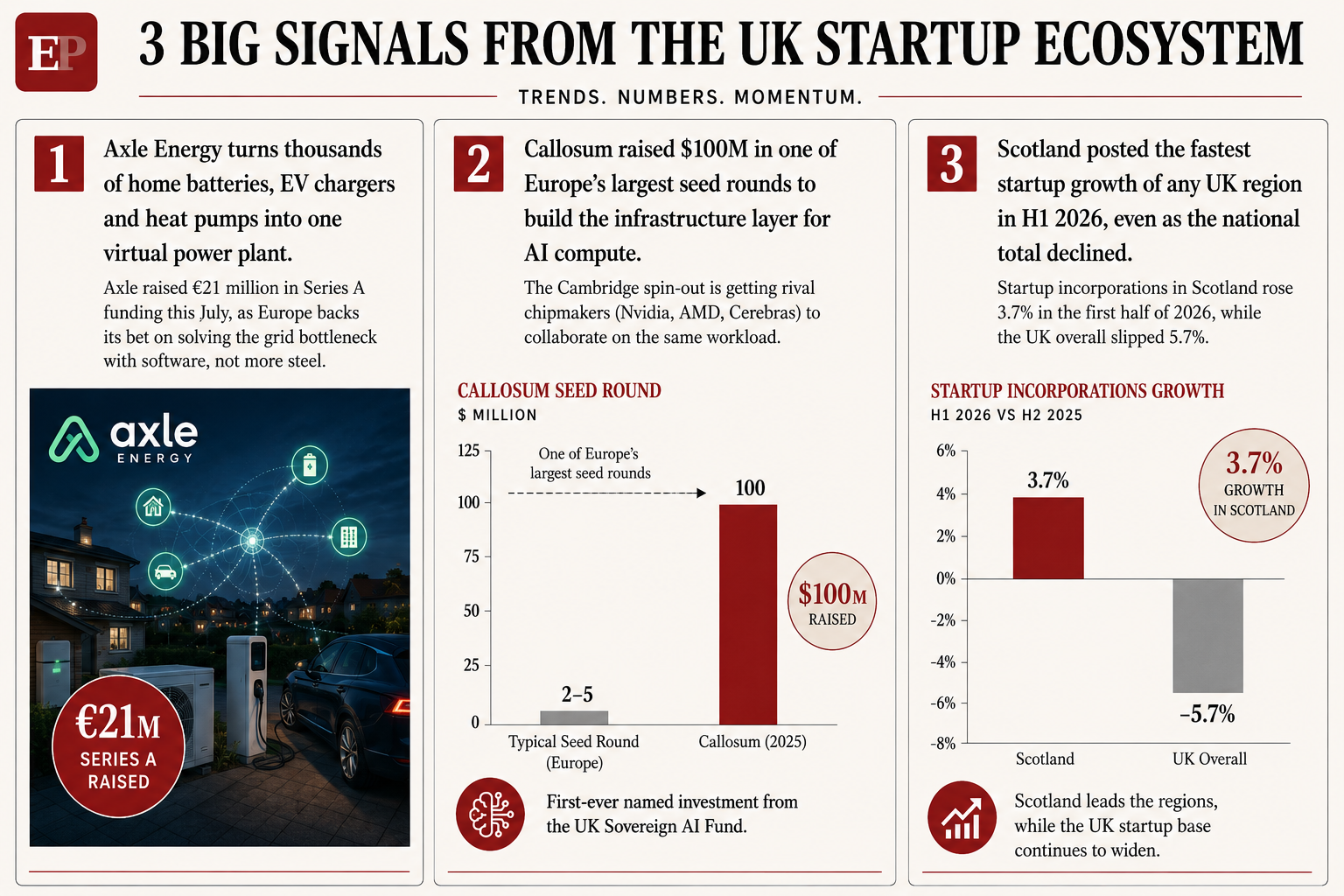
Axle Energy doesn't own a single battery, it just turns other people's, the ones sitting in home batteries, EV chargers and heat pumps up and down the country, into something that behaves like one big power plant.
Our own battery storage Spotlight flagged Axle this week as one of three distinct bets on Britain's grid bottleneck.
Turns out the rest of Europe is watching the same company.
Axle raised €21 million in Series A funding this July, and this week EU-Startups named it one of ten European gridtech startups worth watching, alongside battery-optimisation platforms in Helsinki, Munich and Copenhagen all chasing the same problem: a continent generating power faster than its wires can move it.
A very different kind of infrastructure bet landed in the UK this week too.
Callosum, a Cambridge neuroscience spin-out, raised $100 million in what's being called one of the largest seed rounds in European history, not to build another AI model but to get chipmakers who normally compete (Nvidia, AMD, Cerebras) to work together on the same workload. It's also the UK Sovereign AI Fund's first-ever named investment.
Two very different bets on the same instinct: infrastructure, not the product sitting on top of it, is where the money's actually going this year.
And the base underneath all of it keeps widening regardless.
Scotland just posted the fastest startup growth of any UK region in H1 2026, up 3.7% on the back half of last year, even as national incorporations dipped 5.7% overall.
One pattern we noticed
Funding Circle spent a decade building the exact thing it eventually shut down.
Axle Energy chose not to own a single battery, betting that coordinating other people's assets would be worth more than building its own.
Callosum isn't trying to out-build Nvidia or Cerebras. It's betting its entire seed round on getting them to cooperate instead.
None of this week's biggest stories were about building the obvious thing. They were about betting that the more valuable business sits one layer removed from where everyone assumed the value was.
One number
$100 million — what Callosum raised in seed funding this week, one of the largest seed rounds in European history, and the UK Sovereign AI Fund's first-ever named investment.
Question of the week
Would you rather be the unicorn everyone's chasing, or the plumbing every unicorn needs to survive?
Email us at [email protected] and tell us, we read every single answer, and yours might end up in next week's brief.


