

A teenager arrived in Cambridge to learn English and never really left. Decades later, ARM Holdings, the company he built from a converted barn with no budget and twelve engineers, ended up inside the vast majority of the world's smartphones, and once, by his own account, inside the deal that kept Apple itself alive.
In December 1978, Hermann Hauser and Chris Curry put in £50 each and registered Cambridge Processor Unit Ltd. Curry had spent over a decade working alongside Clive Sinclair, and Hauser was a young physicist with a network of fellow engineers around Cambridge and a hunch that the emerging world of microprocessors was about to matter.
Their first paying job was building a controller unit for a fruit machine.
Within a year they'd spun out a separate company: Acorn Computers.
It's the kind of founding story that sounds almost quaint next to today's seed rounds, and we think that's exactly the point as well. Acorn Computer's actual break came in 1981, when the BBC awarded it the contract to build the BBC Micro, part of a government push to put a computer in every UK classroom. It sold 1.5 million units and made Acorn a genuine national name.
Building a Chip With No Money and No People
Here's the part of the story we find most instructive. By the early 1980s, Acorn wanted to build more powerful machines, but the commercial processors on the market weren't good enough, or cheap enough, for what they needed.
Intel wouldn't sell Acorn the die for its chip on terms Acorn could use, so Hauser made an unusual call: build their own 32-bit RISC processor from scratch.
"Two distinct advantages: no money and no people." — Hermann Hauser, on what he gave the original ARM design team.
Steve Furber and Sophie Wilson, the two engineers tasked with the job, had to make the RISC processor design radically simple because they had no other option. The first ARM reference model ran to just 808 lines of BASIC. When the first silicon came back in 1985, it worked the first time and drew so little power that the test equipment initially registered nothing at all.
We think there's a real lesson in that constraint, one that gets lost in most retellings of deep-tech success stories: ARM's defining commercial advantage, low power consumption, wasn't a strategic bet from a well-funded lab. It was what happens when a small team with no budget is forced toward elegance instead of brute force.
The Spin-Out Nobody Was Sure Would Work
Acorn Computer hit financial trouble in the mid-1980s and was bought out by Olivetti, where Hermann Hauser became VP of Research. Meanwhile, Apple, developing what would now become the Newton handheld, wanted Acorn's chip design badly, but didn't want to build a product on the intellectual property of a company it viewed as a competitor.
The solution, arranged by Hauser, was to spin the chip team out entirely.
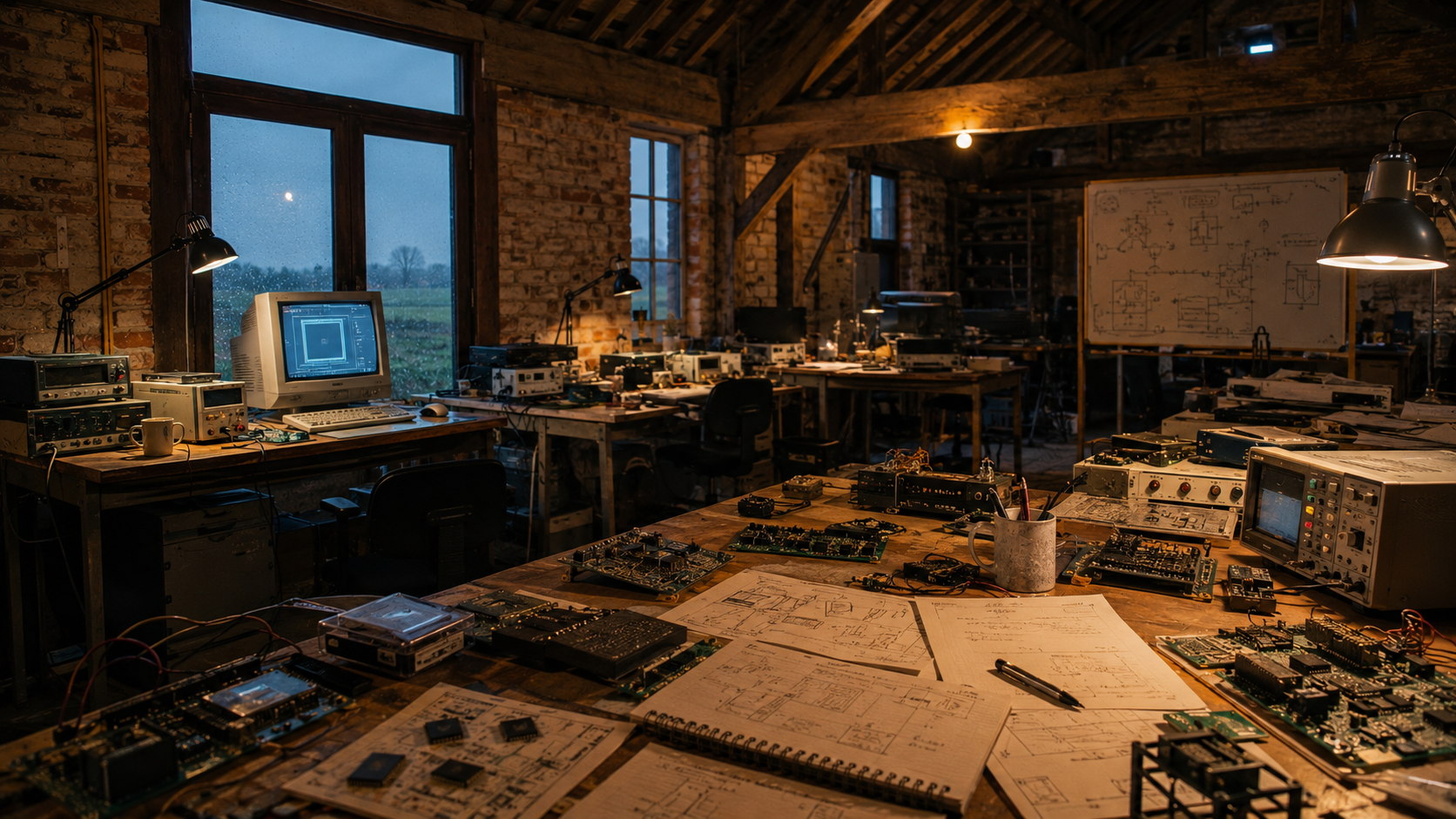
In November 1990,Advanced RISC Machines Ltd - the company that would become ARM Holdings - was founded as a joint venture: Apple put in $1.5 million in cash for a 43% stake, Acorn contributed the same equity share along with the twelve engineers who'd built the technology, and VLSI Technology took 5% in exchange for design tools. The new company's first office was a converted 17th-century barn just outside Cambridge. Robin Saxby, brought in as founding CEO, had once tried and failed to sell Acorn a Motorola chip years earlier, and knew Hauser well enough that the two had skied together in Austria.
The Newton itself, launched in 1993, wasn't the commercial hit anyone hoped for. What saved the fledgling company was Saxby's decision to abandon the idea of manufacturing chips directly and instead license the architecture to anyone who wanted to build on it, an unusual model at the time that let ARM's designs spread across the entire industry without ARM ever needing the capital to build its own factories.
The Twist Almost Nobody Remembers
This is the detail we think deserves far more attention than it gets. By the mid-1990s, Apple was in genuine danger of running out of money, the period before Steve Jobs returned.
"John Sculley said that Apple would have gone bust if they had not been able to sell this stake for $800m when they were in deep trouble before Steve Jobs came back." — Hermann Hauser, on Apple's 43% stake in ARM
So, the chip architecture born from Acorn's constraint, spun out partly because Apple didn't want to touch Acorn's own intellectual property directly, ended up being one of the things that kept Apple itself alive long enough for its actual turnaround to happen. We don't know how differently the entire personal technology industry looks if that stake sale hadn't been there to lean on.
From One Barn to an Entire Ecosystem
ARM Holdings listed on the London Stock Exchange and Nasdaq in 1998; today, ARM remains headquartered in Cambridge, has grown vastly larger than the twelve engineers who started it, was acquired by SoftBank in 2016, and was re-listed on Nasdaq in 2023 at a valuation in the tens of billions of dollars, but we think Hermann Hauser's more lasting contribution isn't ARM itself.
It's what he built after it.
In 1997, he co-founded Amadeus Capital Partners, a venture firm that has spent nearly three decades backing the next generation of Cambridge deep-tech companies, and he's been described repeatedly as one of the central figures behind what's now known as the Cambridge Phenomenon, the cluster of university spinouts and technology firms that turned a university town into one of Europe's most productive deep-tech ecosystems. He's continued that work into quantum computing in recent years, sitting on the European Innovation Council's board, still, by his own account, splitting his time between an office in Mayfair and the city where he did his PhD nearly five decades ago.
What We'd Still Like to Ask
Hauser built ARM's defining advantage out of having no money and no engineers to spare. He now sits on the European Innovation Council's board backing quantum computing companies that, by comparison, are awash in capital from day one. We'd like to ask him whether he thinks that constraint, the one that forced ARM toward elegance instead of brute force, is something today's well-funded deep-tech founders are missing entirely, or whether he's simply found a new way to look for it in the companies he now backs.
Editorial Note
This piece was compiled from public reporting, Acorn Computers and ARM Holdings' own official company history, and archived interviews with Hermann Hauser, rather than a direct conversation.. If Dr Hauser or anyone at Amadeus Capital Partners would like to add to, correct, or expand on this account, we would welcome their input please reach out to the EP+ editorial desk.
Also read: The Woman Who Built Britain's Angel Investors Network for Female Founders
Sources: Arm Newsroom — The Official History of Arm; SemiWiki — A Brief History of ARM Holdings; The Chip Letter — The Arm Story, Parts 1–3; Ingenia — Dr Hermann Hauser CBE FREng: An Inspiring Entrepreneur; Archives of IT — interview with Dr Hermann Hauser; Business Weekly — 40 Years of the ARM Chip; Wikipedia — Hermann Hauser, Acorn Computers, Arm Holdings; European Innovation Council — Hermann Hauser biography.


