

In 2005, five people who had worked at the UK's first internet bank decided the banking industry didn't need another bank. It needed no bank at all.
That was the pitch behind Zopa a website where ordinary people lent money to other ordinary people, and the bank in the middle simply vanished. Two decades, one dead founder, one collapsed industry, and one full banking licence later, Zopa is still standing. It just isn't the company it started as.
So how does Zopa make money today? Not the way it used to. And that's the story.
What Is Zopa?
Zopa is a British digital bank that began life as the world's first peer-to-peer lending platform, launched in March 2005 by a team including Richard Duvall, James Alexander, Giles Andrews, David Nicholson and Tim Parlett. The founders had come from Egg, the UK's pioneering internet bank, and they built Zopa on a simple idea: cut the bank out of lending altogether, and let savers lend directly to borrowers online.
It worked, for a while, spectacularly. Richard Duvall, Zopa's co-founder and first CEO, died of pancreatic cancer in October 2006, just a year after launch, at the age of 44. The company he'd started kept going without him, steered by the remaining founders, and spent the next decade proving that peer-to-peer lending wasn't a gimmick.
By the mid-2010s, Zopa had become one of the three names alongside Funding Circle and RateSetter that defined UK P2P lending. Then, in November 2016, it made a decision that would define everything that came after: it announced plans to become a bank.
What Is Zopa Bank? From P2P Pioneer to Full Bank
Zopa Bank is the fully regulated UK bank that Zopa built on top of its original peer-to-peer platform, gaining a restricted banking licence in December 2018 and a full licence in June 2020. Ask what is Zopa Bank today and the honest answer is: not much like the marketplace of 2005, even though the transition wasn't instant the P2P business kept running for another eighteen months after the full licence, only closing in December 2021.
The Zopa business model shifted from matching individual lenders with individual borrowers to something far closer to conventional banking taking customer deposits and lending against its own balance sheet.
Fixed-term savings products launched shortly after the full licence went live in June 2020, with Zopa's first credit card following in October 2020. The peer-to-peer marketplace ran alongside the new bank for another year before Zopa closed it to retail investors for good in December 2021, with the bank itself buying up the outstanding P2P loan portfolio.
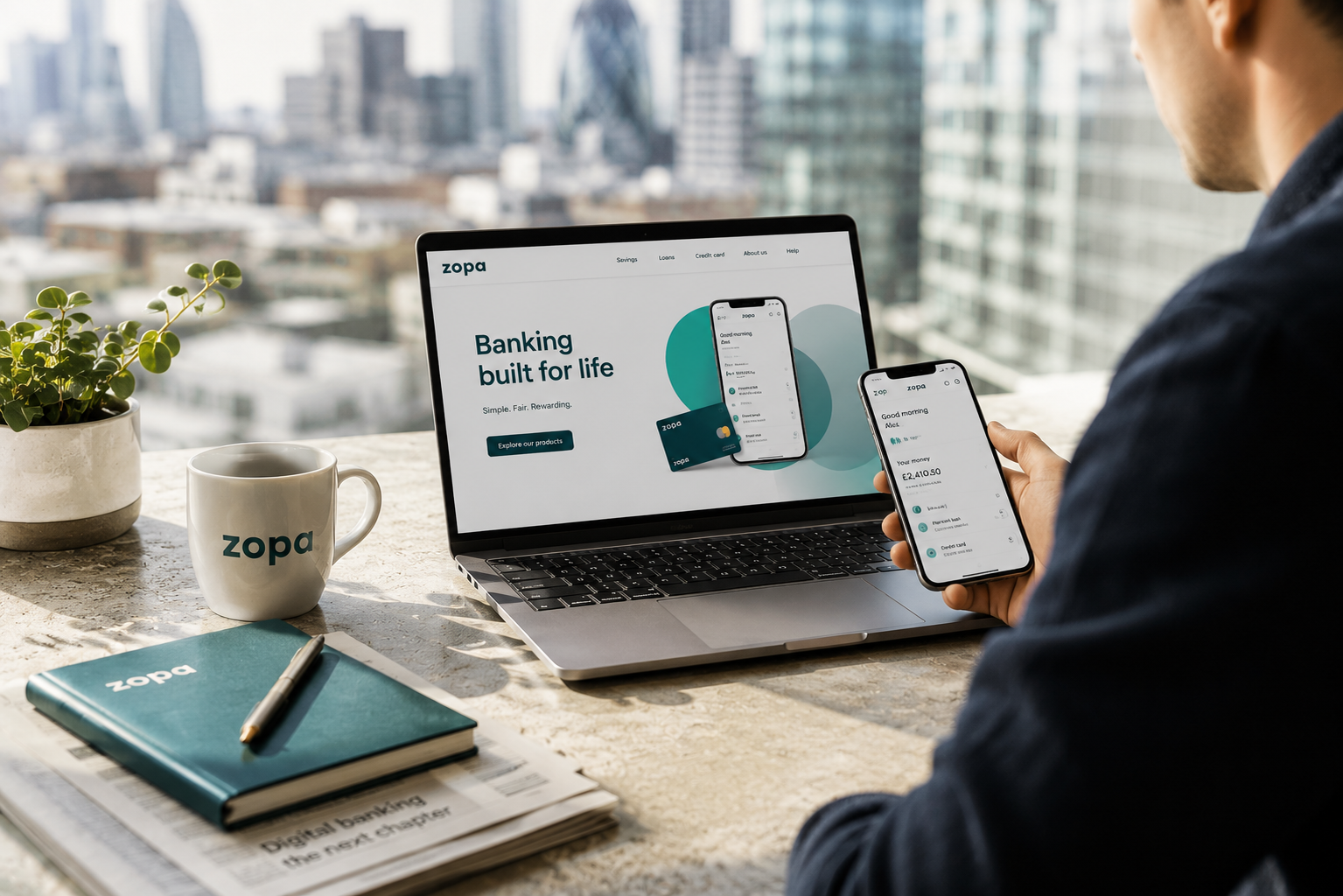
Headquartered in Canary Wharf and led by CEO Jaidev Janardana, Zopa Bank now looks less like the scrappy marketplace of 2005 and more like a genuine challenger bank one with a current account, savings products, credit cards and, since a February 2023 acquisition of DivideBuy, buy-now-pay-later lending.
How It Makes Money: Loans, Cards, Savings
The plain answer to how does Zopa make money today is that it operates like any licensed bank, lending out deposits at a higher rate than it pays to hold them, and charging for credit products, rather than taking a fee as a middleman between lenders and borrowers. Personal loans, credit cards, car finance and a Zopa savings account now sit at the centre of the business, alongside its newer BNPL line.
The scale of the shift shows up clearly in the numbers. In its 2024 financial year, Zopa's total revenue climbed 30.2% to £303.4 million, with total operating income up 33.9% to £297.8 million the bulk of it net interest income (£279.3 million), with fee, commission, swap and other operating income making up the rest. Its customer base grew 28.1% to 1.4 million, deposits much of it sitting in the Zopa savings account range surged 62.5% to £5.5 billion, and loans on the balance sheet rose 16.2% to £3.1 billion. Profit before tax, excluding share-based payments, doubled to £34.2 million in 2024, up from £15.8 million the year before (statutory profit before tax was £31.6 million).
By its 2025 results, Zopa reported underlying profit before tax of £65 million nearly double the year before on revenue of £377 million, with deposits reaching £6.4 billion and loans up to £3.8 billion (statutory profit before tax was £44.9 million). Customers had grown to more than 1.7 million, and more than one in four now holds more than one Zopa product, a multi-product pattern that a Zopa savings account, as the entry point for many customers, is well placed to feed into.
It's a useful way to answer what is Zopa Bank when you're staring at the balance sheet: a lending machine funded largely by deposits, not fees. That's the honest answer to how does Zopa make money in one line deposits and net interest income sit at the core, with lending and cards layered on top, and the whole thing runs on a cost-to-income ratio (34.8% in 2025, excluding share-based payments) that's tight even by neobank standards.
Why It Survived P2P's Collapse
Zopa's exit from peer-to-peer lending came as the UK's wider P2P industry went through serious upheaval, though Zopa itself has pointed to a more specific set of reasons: damaged customer trust in the P2P model, rising regulatory costs, and doubts about whether the marketplace could remain commercially viable over the long term. Between 2020 and 2022, several of Zopa's former peers exited the same market: RateSetter was absorbed into Metro Bank in 2020, Funding Circle closed its retail platform in March 2022, and Assetz Capital followed in December 2022. The industry's own trade body, the P2P Finance Association, disbanded.
Earlier shocks hadn't helped public confidence either; the 2018 collapse of property lender Lendy, with more than half its £160 million loan book in default, had already dented trust in the wider P2P sector well before Zopa made its own exit.
That shift is central to how the Zopa business model works today deposits replaced retail investor money as the fuel for lending, with the bank carrying the credit risk itself rather than passing it on to individual lenders.
Zopa vs Other UK Neobanks
Zopa is smaller than Monzo, Starling and Revolut by customer count, though the numbers aren't perfectly comparable. Zopa and Monzo report UK customers, Starling reports open accounts, and Revolut reports customers globally. Monzo reported 9.7 million customers in its 2024 financial year, up 31%, with deposits climbing to £11.2 billion.
Starling reported 4.6 million accounts and £714 million in revenue for the year ended 31 March 2025, though its statutory profit before tax fell to £223 million, weighed down by a £29 million FCA fine over financial crime control failings and a £28.2 million provision linked to Bounce Back Loan Scheme issues, among other legacy costs.
Revolut, the largest of the four, passed 50 million customers globally in November 2024 and reported £1.1 billion in profit before tax for the year (£790 million net profit).
Zopa's 1.7 million customers look modest next to those figures.
Compared with Monzo, Starling and Revolut, the Zopa business model looks narrower by designing fewer products, chasing depth over breadth. CEO Janardana has previously cited average revenue per customer of £244, from a period when Zopa had around 1.2 million customers, as higher than Monzo's or Revolut's though that's his own comparison rather than an independently verified figure, built on loans, cards and Zopa savings account balances rather than a broad current-account push.
The Bottom Line
Zopa's story is really about two companies wearing one name. The first invented peer-to-peer lending and ran it for sixteen years. The second built a licensed bank alongside that original platform, and gradually wound the P2P side down until it closed for good in December 2021.
What is Zopa Bank, at the end of all this reinvention? A licensed institution built on the bones of a marketplace, still fundamentally about connecting people's money with people who need it just with a balance sheet in between now. That's still how does Zopa make money in 2026 not through the marketplace fee it charged in 2005, but through deposits, loans and cards, run at a cost-to-income ratio most banks would envy.
FAQs
1. How does Zopa make money?
Zopa makes money as a licensed bank taking customer deposits through products like its savings account, then lending that money out through personal loans, credit cards, car finance and BNPL. In 2024, this model generated £303.4 million in revenue and £34.2 million in profit before tax, excluding share-based payments.
2. Is Zopa still a peer-to-peer lender?
No. Zopa closed its peer-to-peer lending platform to retail investors in December 2021, after gaining a full UK banking licence in June 2020. It now operates entirely as Zopa Bank, funded by customer deposits rather than individual lenders.
3. What happened to Zopa's P2P platform?
Zopa wound down its P2P platform in December 2021, with Zopa Bank buying the outstanding loan portfolio from its retail investors. Zopa cited damaged customer trust in the model, rising regulatory costs, and doubts about the marketplace's long-term commercial viability as the main drivers behind the exit.
Also read: Inside Femtech Investment UK: The Founders Betting Everything on Valerie's Next Chapter
Sources: Data drawn from Zopa Bank's own results announcements and Annual Report (FY2024, FY2025), Wikipedia, the Financial Times, Computer Weekly, Sifted, Crowdfund Insider, and reporting on Monzo, Starling and Revolut's FY2024/FY2025 results. Figures reflect the most recent available data at the time of writing.
The EP+ Editorial Desk covers UK startups, founder stories, and venture capital. All editorial content is independently produced and human-reviewed before publication.


