

Victor Riparbelli and Steffen Tjerrild didn't set out to build a pricing model. They set out, in 2017, to let anyone "make a Hollywood film from a laptop." Eight years on, the laptop bit stayed. The film bit didn't.
What emerged instead was a London-founded AI company that turned corporate training videos into a $2.1 billion business.
The Synthesia business model is simpler than the product demo makes it look, and considerably more lucrative than a text-to-video toy suggests understanding how Synthesia makes money means understanding a very specific bet: that enterprises will pay handsomely to never film a training video again.
The AI Video Platform Behind the Numbers
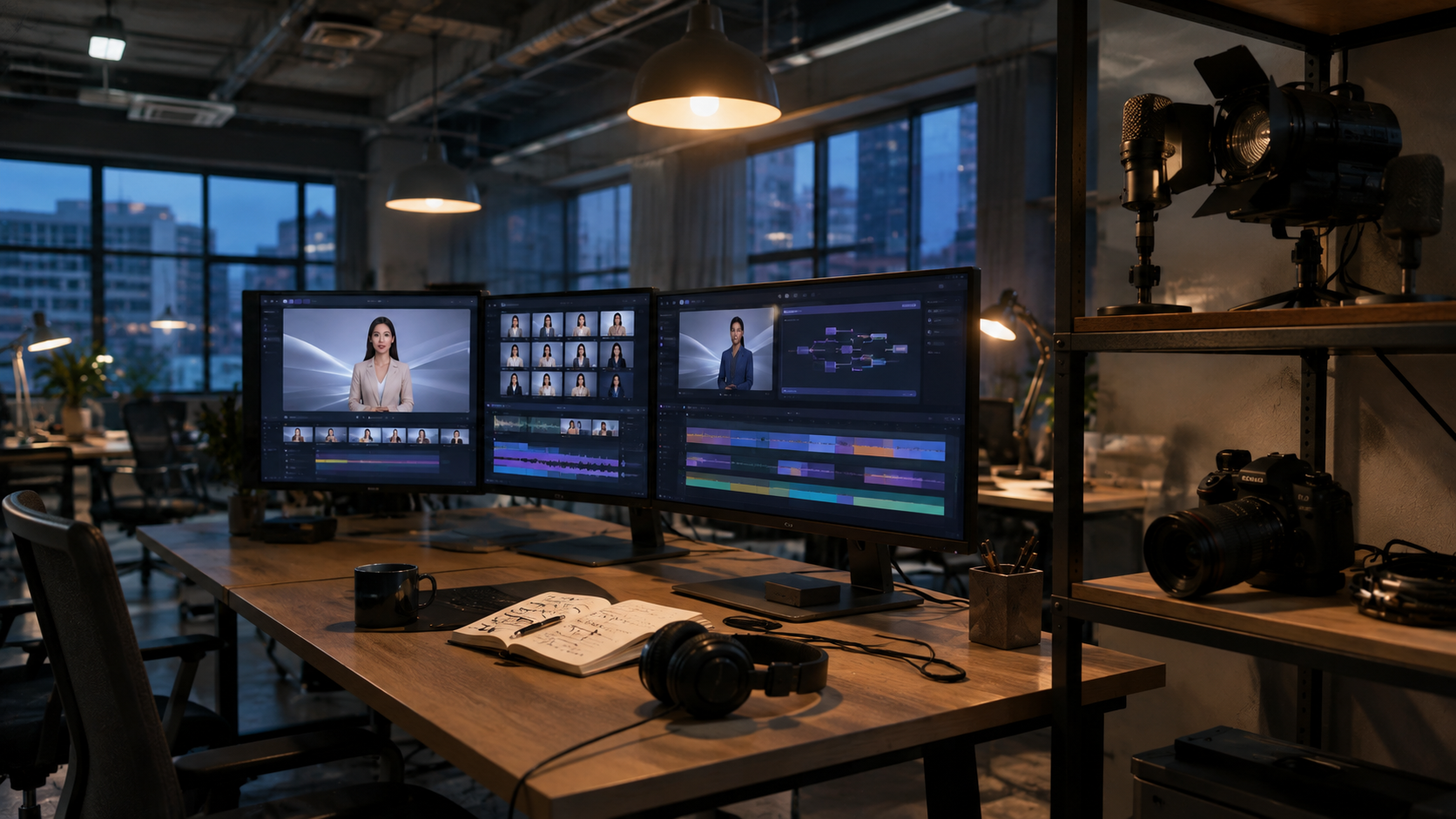
Synthesia is a British AI company, founded in London in 2017, that converts written scripts into finished video using AI avatars instead of cameras, actors, or studios. The founding team Riparbelli, Tjerrild, and academics Professor Matthias Niessner (TUM) and Professor Lourdes Agapito (UCL) built the platform around a simple substitution: type a script, and an AI avatar delivers it on screen, lip-synced and voiced, in minutes rather than days.
That's the honest answer to what is Synthesia at product level. But the more interesting answer, for anyone trying to understand the business rather than the demo, is who it's actually built for. This was never really a consumer tool. Synthesia's own "About" page frames its mission around helping organisations train, onboard, and upskill employees and that framing shows up everywhere in the business model, from the pricing tiers to the customer list. The product looks simple. The commercial logic behind it isn't.
The Video Localisation Problem It Solves
The average Synthesia customer creates content in seven different languages, and 40% of all videos generated on the platform are translated versions rather than originals (Sacra, 2026). That single statistic explains more about how Synthesia makes money than any feature list could.
Multinational organisations don't just need one training video, they need the same training video in German, Japanese, Portuguese, and a dozen other languages, updated every time a policy changes. Traditionally, that meant re-booking actors, re-filming, or paying for dubbing studios in every market. Synthesia's language coverage has expanded over time, and current third-party product reviews put it at approximately 160+ languages for avatar lip-sync, up from the 120+ figure reported in earlier 2025-era coverage worth confirming against Synthesia's live pricing page before publishing, since coverage figures update frequently. The avatar library has grown alongside it, with recent reviews citing 240+ AI avatars, versus the ~180+ figure reported through most of 2025. Synthesia also layered a dedicated AI Dubbing product on top in 2025, letting businesses translate existing videos with frame-accurate lip-sync. There's even a "Secure Editing" workflow built specifically so regulated industries can review translation changes before anything goes live. This is the quiet engine room of the business: localisation isn't a feature bolted onto the platform, it's a large share of the reason enterprises renew.
How It Makes Money: Per-Seat and Enterprise Contracts
Synthesia pricing runs on a tiered subscription model, charging per seat on self-service plans and negotiating custom annual contracts for enterprise customers and that split is the crux of how Synthesia makes money.
Here's how Synthesia pricing broke down across its four tiers as of July/August 2026:
On paper, the ladder above looks like any SaaS pricing table. In practice, it's a lead-gen mechanism for the enterprise tier, where the real revenue sits. Synthesia derives 70% of its revenue from enterprise deals, and net revenue retention exceeded 140% as of April 2026, with contracts above $100,000 tripling over the prior twelve months (Sacra, 2026). Third-party estimates not company-disclosed figures, worth flagging as such put typical enterprise contracts somewhere between $20,000 and $100,000+ a year depending on seat count and language coverage, with a median around $30,000 for mid-market deployments, per Vendr data cited by CheckThat.ai in 2026.
There's a second, less obvious lever too: add-ons. According to third-party pricing sources, custom "Studio Avatar" creation costs around $1,000 per avatar per year on top of a subscription, a figure that isn't prominently disclosed on Synthesia's own pricing page and overage minutes on the lower tiers are billed separately once an account exceeds its allowance. That's what Synthesia pricing is ultimately designed to do: make the Enterprise conversation feel inevitable once a team scales past a handful of seats. That structure is the Synthesia business model in miniature entices with self-serve pricing, then graduates serious users into custom enterprise contracts.
Why Fortune 100 Companies Use It
At the time of its January 2025 Series D, Synthesia said over 60% of Fortune 100 companies were customers. Named customers across the enterprise base include Zoom, Heineken, Inter IKEA Group, Bosch, Merck, and SAP.
Scale is the obvious draw, but it's not the only one. Large organisations gravitate to Synthesia because updating a training video is now a text edit, not a re-shoot of a genuinely different cost structure for a compliance team that needs to push out a policy change to twelve country offices by Friday. SOC 2 Type II compliance, SSO, and SCORM export on the Enterprise plan give procurement teams the governance boxes they need to tick, while the per-seat pricing model scales cleanly as a deployment grows from one team to the whole company. For a business built almost entirely on enterprise trust, that combination of real cost savings plus real security credentials does more selling than the avatars themselves.
The Content Localisation Moat
Synthesia's edge over rivals like HeyGen, Colossyan, and Hour One isn't better-looking avatars; it's owning the full publishing stack, not just the export button. Sacra's 2026 analysis notes that Synthesia owns its video player and distribution layer, letting it track engagement analytics end-to-end rather than simply handing over an MP4 and losing visibility the moment the file leaves the platform.
Competitors have chased Synthesia's lead in different ways. HeyGen, estimated at around $95 million in ARR, has built strength among individual creators and SMBs and is now pushing upmarket. Colossyan raised a $22 million Series A in 2023 but remains considerably smaller in enterprise presence. Hour One raised around $20 million in its own 2022 Series A.
None currently match Synthesia's language coverage or its enterprise trust signals at scale which is precisely why the localisation story matters more to the business than a straightforward features comparison ever could. It's not selling avatars. It's selling the infrastructure for one script to become fluent in dozens of markets, tracked and secured the whole way through.
The Bottom Line
Synthesia was valued at $2.1 billion in January 2025, after raising $180 million in a Series D round led by NEA bringing total funding at that point to over $330 million (Synthesia, official press release). The company's filed UK accounts show $58.3 million in recognised revenue for the year ended 31 December 2024, alongside a $59.2 million pre-tax loss driven by continued investment in headcount and technology (Sacra, 2026). By April 2025, Synthesia had crossed $100 million in annual recurring revenue, according to its own announcement.
The figures haven't stood still since. Synthesia went on to raise a further $200 million Series E, led by Google Ventures, lifting its valuation to $4 billion worth knowing if you're reading this well after January 2025. That trajectory captures the Synthesia business model in one sentence: land enterprise customers, keep them renewing for localisation, and let seat expansion do the rest. The $2.1 billion moment remains the clearest single snapshot of how Synthesia makes money at scale.
FAQ
1. What is Synthesia?
Synthesia is a London-based AI company, founded in 2017 by Victor Riparbelli and Steffen Tjerrild, that turns written scripts into finished video using AI avatars. It replaces cameras, actors, and studios with a text-to-video workflow built primarily for enterprise training, onboarding, and internal communications.
2. What is Synthesia's valuation?
Synthesia was valued at $2.1 billion following its January 2025 Series D round, a $180 million raise led by NEA. That valuation has since risen to $4 billion after a further $200 million Series E led by Google Ventures.
3. Who uses Synthesia?
Enterprise learning and development, HR, and internal communications teams are Synthesia's core users. Over 60% of Fortune 100 companies were customers at the time of its $2.1 billion valuation, including named clients such as Zoom, Heineken, Bosch, Merck, and SAP.
Sources: Synthesia's own press releases and About page, Reuters, Sacra's 2026 company analysis, CheckThat.ai, and third-party funding trackers including Tracxn and CB Insights. Figures reflect the most recent available data at the time of writing, with estimates flagged as such where no company-disclosed figure exists.
The EP+ Editorial Desk covers UK startups, founder stories, and venture capital. All editorial content is independently produced and human-reviewed before publication.


