

Britain now has a squadron dedicated to just space.
The Ministry of Defence recently unveiled the UK space squadron - No. III Space Effects Squadron - at the UK Space Power Conference in London, tasked with protecting satellites, countering hostile activity in orbit, and running offensive and defensive space operations.
It joins No. I Space Operations Squadron and No. II Space Warning Squadron inside UK Space Command.
We believe the more interesting story sits one layer down, in the London company whose telescopes are already doing the watching.
Why the UK Needed a Space Squadron
The case for a UK space squadron was made in blunt terms.
Roughly a fifth of the UK economy depends on satellite services - navigation, banking transfers, emergency communications, and military coordination.
The Ministry of Defence has described space as a domain of direct competition, citing attempts to jam UK military satellites used for communication and surveillance.
The government has ruled out destructive anti-satellite missile testing, but it has committed over £3 billion to space capabilities over the next four years, with £880 million earmarked specifically for space-based intelligence, surveillance, reconnaissance, and space control through 2029-30.
That spending sits inside the wider £298 billion Defence Investment Plan, which allocates £31 billion to air and space over four years. Defence Minister Luke Pollard told the Global Air and Space Chiefs' Conference that the RAF's air counterpart, which is currently UK Strategic Command's air arm, will soon be renamed Air and Space Command, a change reflecting how central the space portfolio has become to British defence.
What Space Domain Awareness Actually Means
Much of this new UK military space effort depends on a discipline most people have never heard of: space domain awareness. It means knowing, in real time, what is in orbit, whether it is behaving normally, and whether it threatens a UK asset.
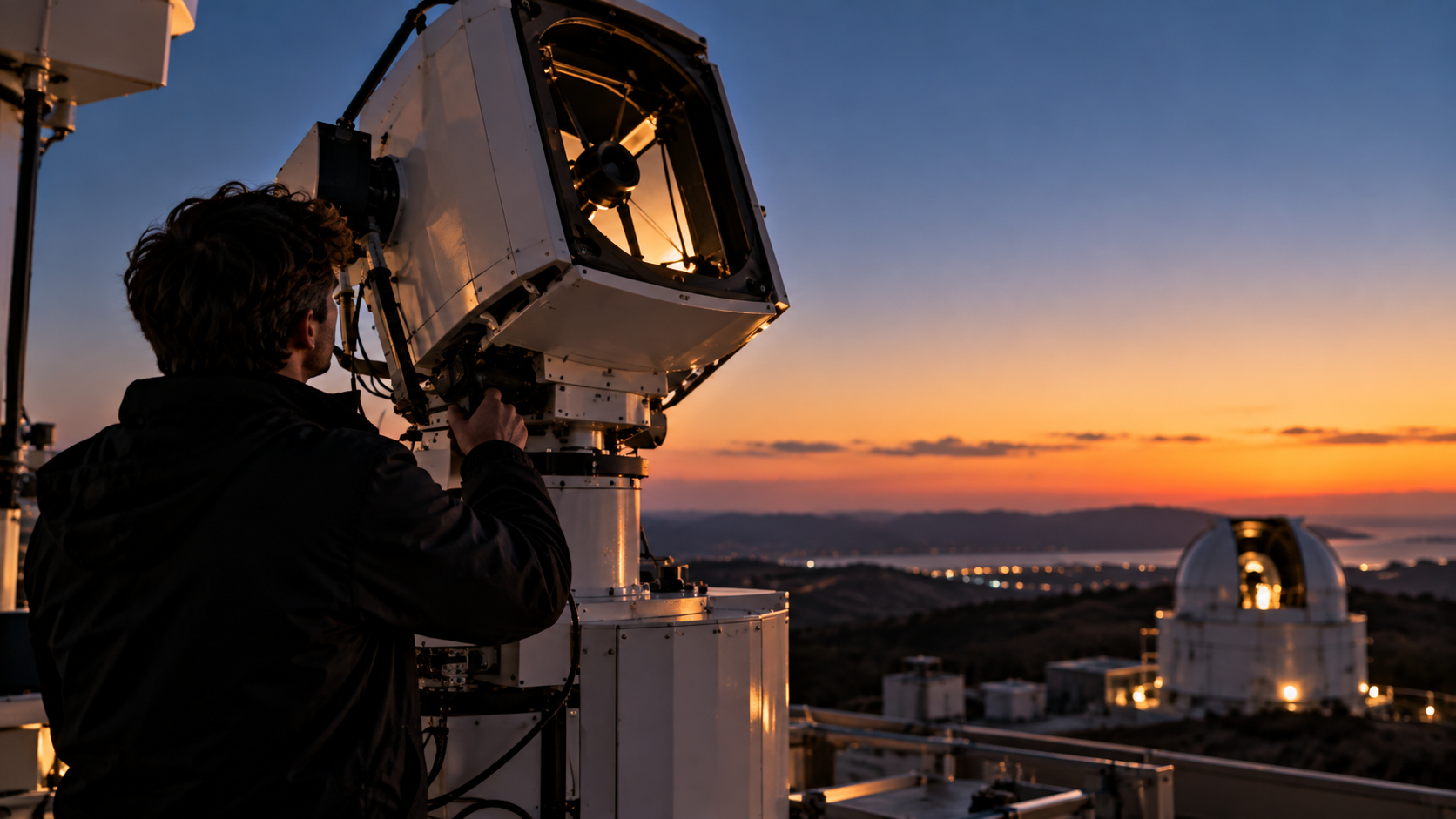
Geostationary satellites 36,000km up cannot be defended if nobody is watching them. That watching job - for the part of the architecture called Noctis-1, based in Cyprus and remotely operated by No. 1 Space Operations Squadron from RAF High Wycombe - is built by Spaceflux, a nine-employee, three-year-old company founded in a London research lab.
Spaceflux launched in 2022 to tackle rising satellite congestion, combining ground-based optical sensors with Short-Wave Infrared imaging for genuine day-and-night tracking, and an AI analytics platform called Cortex to characterise what those sensors see.
Since 2023 it has been the only commercial provider of geostationary tracking data to the Ministry of Defence and the UK Space Agency. In November 2025, it won all three of the UK's major space-surveillance-and-tracking contracts under the National Space Operations Centre framework, and now leads a multiphenomenology consortium bringing in Safran, GMV, Look Up, EOS and Optera to widen the sensor mix.
"As space becomes increasingly essential to our economy, environment and daily lives, it is also becoming more congested and contested." — Marco Rocchetto, CEO and co-founder, Spaceflux
Rocchetto co-founded Spaceflux with Ingo Waldmann and Marcel Debczynski, the company raised £5.4 million in seed funding in July 2025, co-led by Foresight Group, UKI2S (managed by Future Planet Capital) and Blackfinch Ventures, then extended the round by a further £3.5 million in early 2026, bringing total seed funding to £9 million.
That is a modest sum against a £3 billion government programme, but it bought Spaceflux the position of incumbent sovereign supplier at exactly the moment the UK space squadron needed sensors it could trust.
The Startup Behind the Squadron's Eyes
The imagery Noctis-1 has released so far shows the International Space Station and the UK's own Skynet military communications satellites, and that is proof the system works, delivered under a wider, related programme. That companion system, Borealis, is the £65 million, five-year space command-and-control platform built by CGI UK with supporting SMEs, including Spaceflux, and it went operational six months ahead of schedule, supporting around 100 jobs across Leatherhead, Reading and Bristol.
"By combining deep domain expertise with modern engineering practices, we've provided a scalable capability that can adapt as mission demands and the threat landscape continue to evolve." — Neil Timms, Senior Vice President of Space, Defence and Intelligence, CGI
That is the pattern EP+ readers should note: the UK space squadron is a uniformed answer to a genuinely contested domain, but the sovereign capability behind it including the optical sensors, the tracking software, the fused multi-source data, is being built by a handful of small British companies, not by the primes. Spaceflux's growth from a research-lab startup to the country's sole geostationary tracking provider took three years.
Optera, a neuromorphic sensing SME also folded into the Borealis and NSpOC ecosystem, raised £3 million in June 2026 to scale its own UK team, backed by the same investor cluster of UKI2S, Blackfinch and Foresight alongside the National Security Strategic Investment Fund.
What Comes Next
None of this settles whether UK military space spending converts reliably into contracts for founders rather than incumbents. The government's own Defence Investment Plan, when it was announced, made no direct mention of startups, scale-ups or venture capital - the money is aimed at the technologies themselves: drones, AI, autonomy, quantum, and now space domain awareness, with the expectation that the supply chain sorts itself out underneath.
Spaceflux and Optera suggest it can work.
Whether the UK space squadron becomes a template for how Britain buys sovereign capability from its own startups, rather than its usual primes, is the question the rest of this ecosystem will now be watching - much like Noctis-1 watches everything else.
Also read our article on : UK Space Tech Startups: The Sector That's Finally Ready for Commercial Takeoff


