

A card that copies every other card in your wallet just got Lloyds to sign a deal, and here's the maths behind it.
This week's breakdown of the maths behind that deal is worth reading, because Curve was never trying to replace your bank, it’s actually betting that, banks will pay for the layer sitting on top of theirs.
Across town, two other fintech apps were running the opposite experiment and disagreeing with each other about it.
Moneybox charged £1 a month and lost money on it for years, no bank partnership, no clever tricks, just a slow, stubborn relationship with the saver.
This week we found out what finally changed, and it wasn't the price; it was scale finally catching up to a model that never even moved.
Plum went the other way and stacked everything, with four subscription tiers, free up to £14.99 a month, each one layering in cheaper investment fees, better savings rates, and a few lifestyle perks. The revenue comes from subscriptions, investment fees, and transaction income, all at once. £34 million a year, growing past 60% annually; the numbers say it works.
So now we've got three companies with three completely different theories.
Curve says the money's in an incumbent's trust, while Moneybox says the money's in a flat fee and enough patience and Plum says don't just pick one lever, pull all four in fact.
None of them are wrong yet, and that's the interesting part.
Read the full breakdown of How Curve makes money, How Moneybox turned profitable, and what's inside Plum's layered revenue model.
Also on EP+ this week:
→ Most founders think "debt" and "dilution" are the same problem. Venture debt exists because they're not.
→ Catapults are the R&D infrastructure nobody talks about, and the reason several UK deep tech companies got built at all.
→ About a quarter of two-founder teams break up within four years. The ones who never wrote anything down find out the hard way what their co-founder's shares are actually worth.
→ Ten Companies House filing mistakes. Every one of them avoidable in fifteen minutes.
→ Julie Deane built Cambridge Satchel from her kitchen table. Still one of the clearest proofs that British female founders don't need permission to win.
→ Convertible loan notes and SAFEs get used interchangeably by founders who've never compared what happens if the next round doesn't go to plan.
→ UK PropTech keeps promising to fix Britain's broken property market. We checked how close it actually is.
→ The UK's university spinout equity deal just changed. Real money is moving away from institutions and toward the founders who did the work.
The wider ecosystem asked a version of the same question this week
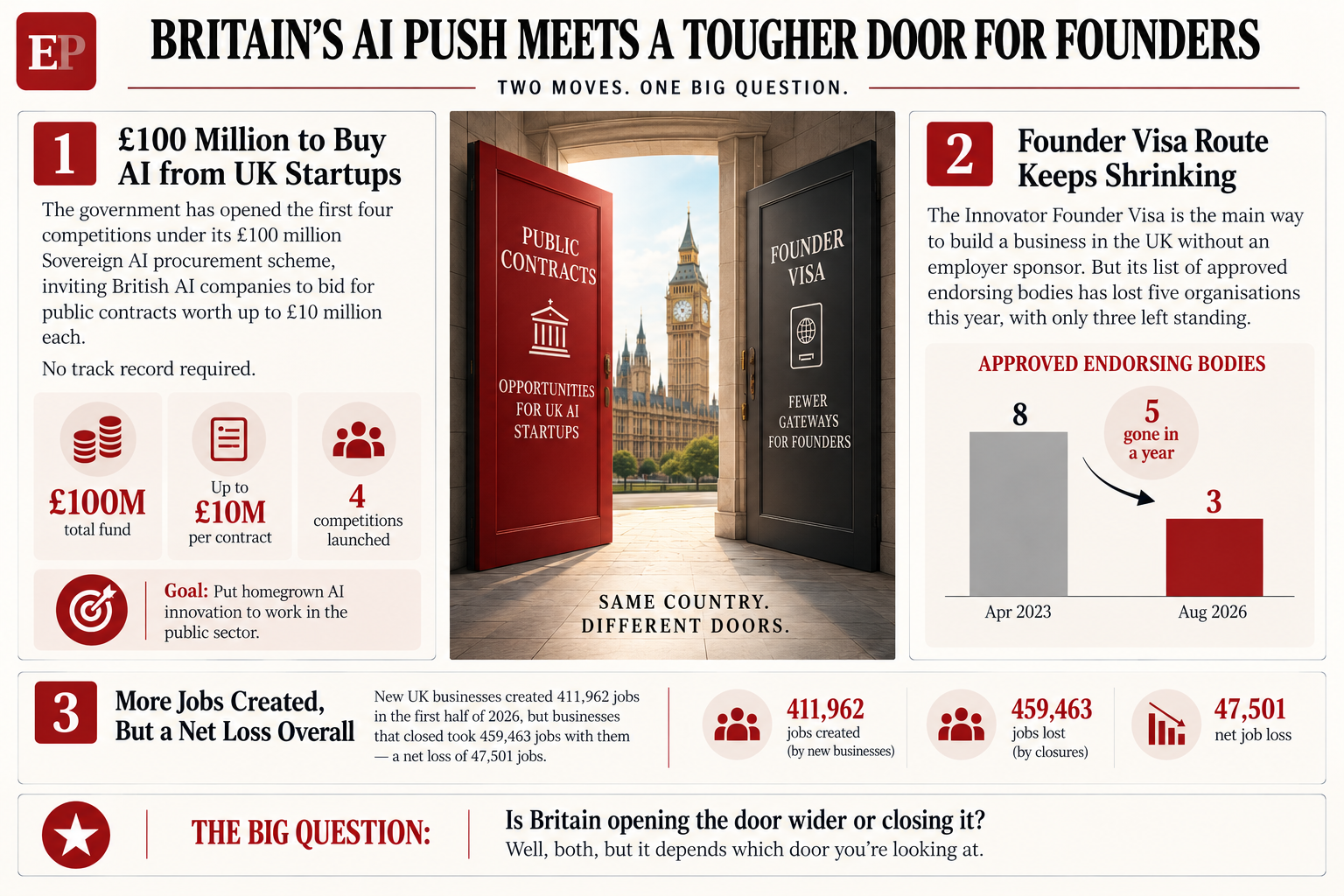
A strange thing happened in Britain this week, the government opened a £100 million competition to buy AI products from British startups. At the same time, one of the main visa routes for founders lost its fifth approved endorsing body of the year.
The Innovator Founder Visa is the main way to build a business in the UK without an employer sponsoring you, no job offer needed, just an idea, and someone official willing to vouch for it. That vouching list has been shrinking since April 2023.
Community and Business Partners came off it in February, Innovate Britain in April, and then, in one month this August, three more disappeared: MedCity, the NatWest Entrepreneur Accelerator, and SFC Capital, so five gone in a year, with three left standing for anyone applying fresh.
Meanwhile, the government's other hand reached the opposite end, it opened the first four competitions under its £100 million Sovereign AI procurement scheme, inviting homegrown AI companies to bid for public contracts worth up to £10 million each.
No track record required.
Is Britain opening the door wider or closing it? Well, both, but it depends which door you're looking at.
Here's the number that ties it together: new UK businesses created 411,962 jobs in the first half of 2026, so businesses that closed took 459,463 jobs with them, with a net loss of 47,501 jobs and a £3.3 billion gap between the value coming in and going out.
Elsewhere, patient capital kept moving anyway, as the British Business Bank committed up to £46 million to Zinc's new deeptech fund, Schroders was picked to help manage a proposed UK Scale-Up Fund, and Nexeon raised $116.7 million for a new battery pilot facility.
One pattern we noticed
Three fintech apps. Three completely different ideas about where profit actually comes from.
Curve leaned on a bank's trust. Moneybox leaned on its customers' patience. Plum decided not to pick, and pulled every lever at once.
Nobody hedged this week, every bet was real, pointed in a specific direction, they just weren't all pointed the same way. Maybe that's the actual state of building in the UK right now, easier in some rooms, harder in others, and nobody coordinating which room you end up in.
One number
5 - the number of Innovator Founder Visa endorsing bodies removed from the approved list in 2026 alone. Just 3 left for new applicants.
Question of the week
If you had to bet on one of this week's three fintech models, incumbent partnership, flat-fee patience, or layered subscriptions, which one would you pick?
Email us at [email protected] and tell us why; we read every single answer, and yours might end up in next week's brief.
Sources: Curve, Moneybox and Plum figures drawn from EP+'s own reporting and Plum's published fees page (effective 27 February 2026). GOV.UK's Innovator Founder Visa guidance and Immigration Rules Appendix Innovator Founder, current as of August 2026. Sovereign AI procurement figures from GOV.UK, Computer Weekly and The Register. UK business formation and closure figures from Cynergy Bank's Business Health Score, via London Loves Business. External deep tech and capital figures from Sifted (UK Scale-Up Fund) and Tech.eu (Nexeon, Certain Energy). Founders agreement figures from Carta's Founder Ownership Reports (2025, 2026) and HSBC Innovation Banking's 2025 Term Sheet Guide.


