


A founders agreement UK companies sign at incorporation isn't a legal requirement company law doesn't force anyone's hand. But skipping one is one of the most avoidable risks a founding team can take, and more founders learn this the hard way each year. Carta's analysis of VC-backed two-founder teams found that roughly a quarter suffered a co-founder breakup within their first four years between 2017 and 2021 even in the best years measured, nearly a fifth had broken up by year four.
Looking further out, among two-founder teams founded between 2016 and 2021, somewhere between 25% and 35% had parted ways after five years depending on the exact founding year, and among those founded 2016–2018, more than 40% had experienced a breakup within eight years (Carta, 2026). That's not a fringe scenario, it's close to a coin flip over a startup's life, and a co-founder leaving without agreement in place is exactly the situation this document exists to prevent.
A founders agreement UK startups put in place is contractually enforceable under ordinary UK contract law, provided the usual requirements are met: offer, acceptance, consideration, and intention to create legal relations though enforceability ultimately turns on the specific terms and how the document was executed, not the mere fact that founders signed something.
It's worth being clear on what a founders agreement isn't: it's signed between the founders (often the company too) at or near incorporation, covering roles, equity, vesting, IP assignment, and departure mechanics. A shareholders' agreement is separate; it governs all shareholders, including future investors, and typically layers on once external funding arrives.
How Co-Founder Equity Splits Actually Work
Most founding teams don't split equity equally, whatever the popular default assumes. Among two-founder teams, Carta's Founder Ownership Report 2025 puts the equal-split rate at 45.9% for teams that incorporated in 2024, up from 31.5% in 2015.
A co-founder equity split decided in the first meeting, before roles and workloads are properly clear, is one of the more common regrets among UK founders. For larger teams the rate drops sharply: three-founder teams reached an equal-split rate of 27.3% in the most recent year measured, up from 21% the year before; four-founder teams reached 16.7%, up from 10.8% (Carta Founder Ownership Report 2026).
Defaulting to 50/50 because it feels fair, or because the conversation feels awkward otherwise, is exactly the trap to avoid. Whatever split you agree, vesting is what actually protects the company if a co-founder walks away early without it, a split fixed at incorporation offers no real protection if someone leaves in month three.
Source: Carta Founder Ownership Report 2025 and 2026 (US/VC-backed dataset UK-specific equivalents aren't publicly available, but the pattern is a reasonable proxy).
The Standard UK Vesting Schedule: 4 Years, 1-Year Cliff
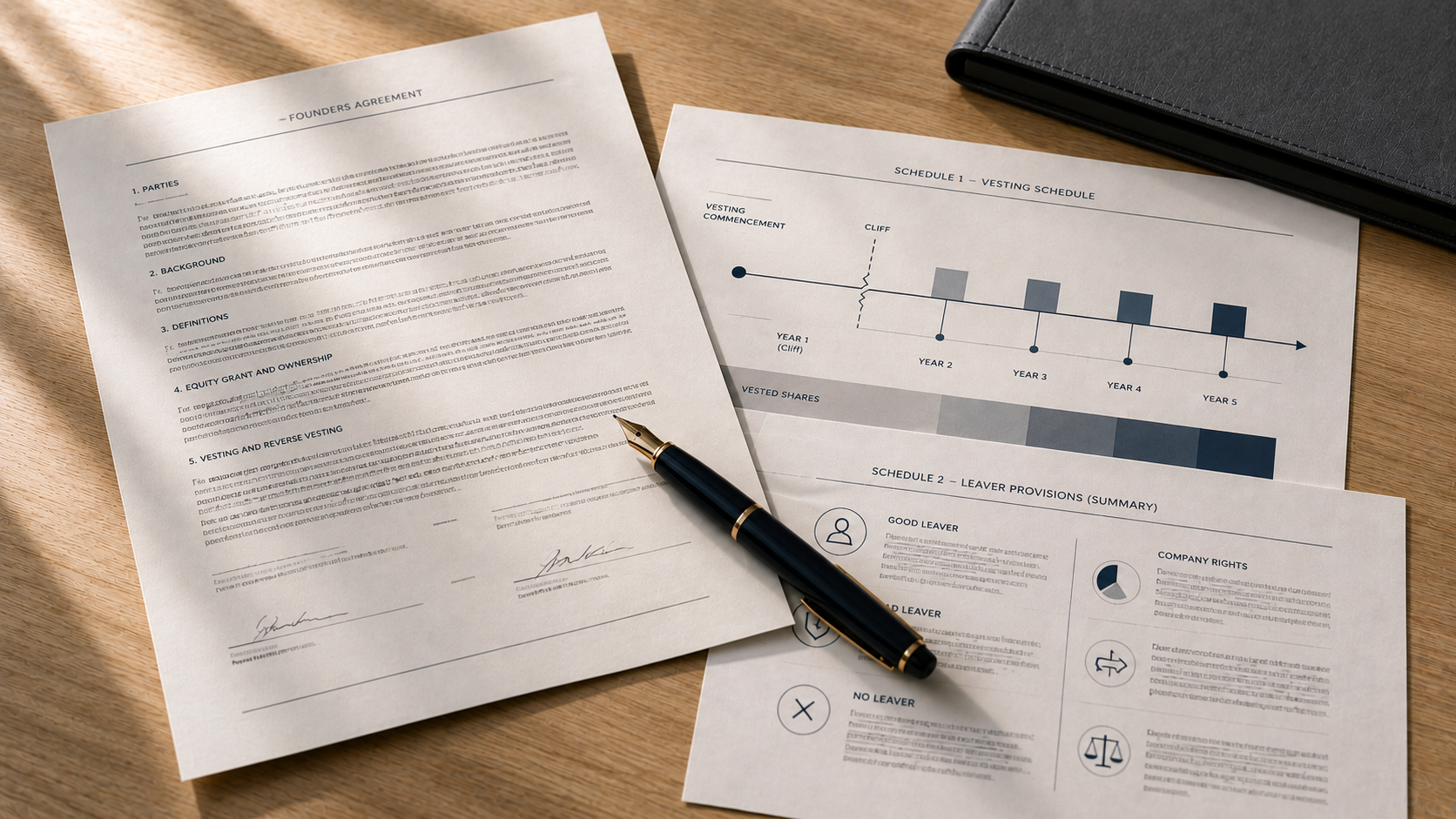
Among the UK term sheets HSBC Innovation Banking analysed in its 2025 Term Sheet Guide, four-year vesting with a cliff was the most popular structure though founder vesting appeared in only 58% of term sheets, meaning 42% were silent on it. Under a typical monthly vesting structure, this 4 year vesting 1 year cliff pattern means nothing vests in the first twelve months, then roughly 25% vests at the cliff, with the remainder vesting monthly over the following three years.
The logic is simple: a founder who leaves after two months shouldn't keep the same stake as one who stays four years, and 4 year vesting 1 year cliff arrangements enforce that automatically rather than relying on goodwill after the relationship has broken down. Since 42% of term sheets don't address founder vesting at all, it's worth raising explicitly rather than assuming it'll be covered later.
Reverse Vesting Explained
Reverse vesting is one common way of structuring founder share arrangements in the UK: unlike an employee option that vests forward and only exists once earned, a founder is issued their full allocation upfront and risks losing the unvested portion if they leave early. In practice, the founder is usually the registered legal shareholder from day one voting rights included while the company typically retains a contractual right to buy back unvested shares on early exit, though the exact mechanism varies by deal.
This isn't a matter of a single clause. The documentation needs coordinating carefully the Articles of Association and the relevant shareholder and vesting agreements so the intended transfer and vesting mechanics can actually be implemented. Poor alignment can make particular provisions difficult or impossible to enforce as intended, which is exactly how a founders agreement UK teams thought they'd sorted can end up not doing what everyone assumed.
There's a tax dimension too. Vesting founder shares can fall within HMRC's Employment-Related Securities regime, and a joint Section 431 election is often used to fix the tax treatment at acquisition rather than later. Certain initial subscriber shares acquired on incorporation may fall within HMRC's specific reporting exception, provided the relevant conditions are met but that doesn't mean the shares stop being employment-related securities once vesting or forfeiture conditions are layered on, so it's not one to assume without checking.
Good Leaver vs Bad Leaver: What Happens When Someone Exits
A good leaver/bad leaver clause decides how much equity a departing founder keeps, based on why they're leaving. A good leaver illness, disability, wrongful termination typically keeps vested shares and may be bought out at fair value; a bad leaver voluntary early exit, misconduct typically forfeits unvested shares, and under the more investor-friendly versions of this term, sometimes vested shares too.
These clauses sound like fine print until they're all that stands between a founder and losing a large chunk of the company to someone who left early. They're negotiated less carefully than they should be: HSBC Innovation Banking's 2025 data found that in 51% of cases, leaver provisions are only handled after the term sheet stage, typically in the shareholders' agreement well after the easier moment to raise them. Set the terms while everyone's still getting on.
What Happens If a Co-Founder Leaves Without an Agreement
A co-founder leaving without agreement in place generally keeps whatever equity they already hold, since there's usually no automatic mechanism in the founders agreement, shareholders' agreement, or Articles to reclaim it. Picture an illustrative example: two founders, 50/50, no shareholders' agreement. One leaves after three months.
Two years on, the other has built the business to a £2m seed offer, and an investor could refuse to proceed until the cap table is resolved. The departed founder, still holding their full 50%, is now in a position to hold the deal to ransom. A standard four year vesting 1 year cliff arrangement, agreed on day one, would have left them with nothing.
The buy-back itself is a separate legal step. Even where a founders agreement UK company has vesting and buy-back rights fully documented, execution is constrained by the Companies Act 2006 under section 692, a limited company can generally only purchase its own shares out of distributable profits or the proceeds of a fresh share issue, though private companies have additional routes to buy back out of capital, including a de minimis procedure under section 692(1ZA) capped at the lower of £15,000 or 5% of fully paid share capital at the start of the financial year. A startup with no distributable profits may need to structure a departure carefully to complete a lawful purchase at all.
What to Include in Your Founders Agreement
A founders agreement UK, founders put together commonly addresses the same ground: roles and decision-making, the co-founder equity split and vesting schedule, IP assignment, confidentiality, non-compete and non-solicitation restrictions (length depends on role and business, so worth specific legal advice rather than a copied template duration), good leaver/bad leaver definitions, dispute resolution, and alignment with the Articles of Association.
Poor alignment there is precisely how a co-founder leaving without agreement provisions that actually bite ends up costing far more than the legal fees would have.
FAQs
1. What happens if a co-founder leaves without an agreement?
A departing co-founder generally keeps whatever equity they already hold, since there's no automatic mechanism to reclaim it. The company then has to negotiate a buyback from a position of weakness, and any buy-back is still constrained by the Companies Act 2006's rules on distributable profits (s.692).
2. Is a founders agreement legally binding in the UK?
A properly drafted founders agreement UK courts will treat as binding under ordinary contract law but it's not automatically enforceable just because founders signed it. Enforceability depends on the specific terms, how it was executed, and whether the usual contract requirements are met.
3. What is a good leaver/bad leaver clause?
It's the clause deciding how a departing founder's equity is treated based on why they left. Good leavers (illness, disability, wrongful termination) typically keep vested shares; bad leavers (voluntary early exit, misconduct) typically forfeit unvested shares, and sometimes vested shares too depending on how the clause is drafted.
Also read: UK Cybersecurity Startups 2026: Building Britain's Digital Defence Industry
Sources: Data drawn from Carta's Founder Ownership Reports (2025, 2026) and founder-departure analyses, HSBC Innovation Banking's 2025 Term Sheet Guide and founder vesting article, HMRC's Employment Related Securities Manual, and the Companies Act 2006 (ss.658, 692, 709–723) via legislation.gov.uk. Equity-split and founder-departure figures reflect Carta's US/VC-backed client dataset — UK-specific equivalents weren't publicly available on founders agreement UK practice at the time of writing.
The EP+ Editorial Desk covers UK startups, founder stories, and venture capital. All editorial content is independently produced and human-reviewed before publication.


