

On 18 September 2025, at Chequers, Donald Trump and Keir Starmer sat down to sign what both men called a generational moment.
The Tech Prosperity Deal promised £31bn in pledges from Microsoft, Google, Nvidia and OpenAI, and a UK-US trade deal built on artificial intelligence, quantum computing cooperation and civil nuclear cooperation.
For a founder watching from a co-working space in Shoreditch or Leeds, it read like a green light.
Ninety days later, that light went out.
We believe the story of this UK-US trade deal is less about the handshake at Chequers and more about what happened to it afterwards, because for the startups this deal was supposed to serve, the gap between the announcement and the reality has become the actual news.
The Deal That Stopped Moving
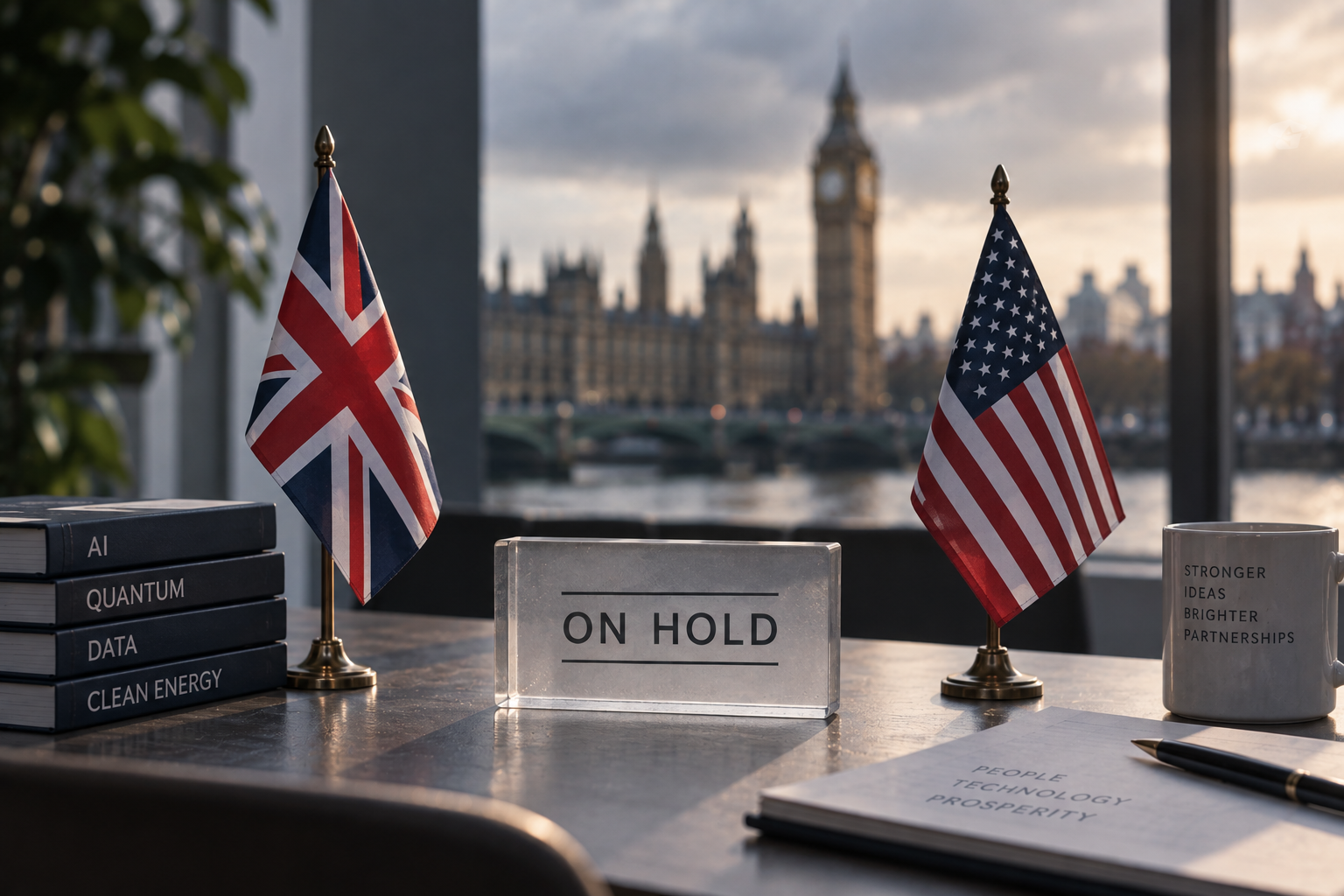
On 16 December 2025, Washington quietly paused implementation, and British officials confirmed the freeze within hours.
The reasons that were cited felt familiar: the UK's Digital Services Tax, a 2% levy on US tech giants that raises around £800m a year, alongside the Online Safety Act's content rules and lingering food safety disputes.
The memorandum behind the UK-US trade deal had always contained a catch, it would only "become operative" alongside progress on a separate Economic Prosperity Deal covering broader trade barriers.
When that progress stalled, so did the tech pact riding on its back.
A UK government spokesperson offered reassurance rather than resolution: the special relationship, they said, "remains strong," and ministers remained "firmly committed" to the Tech Prosperity Deal delivering for people on both sides of the Atlantic.
Business and Trade Secretary Peter Kyle travelled to Washington weeks later in hopes of keeping the momentum alive and later described the negotiations as complex and ongoing rather than broken.
Talks resumed in February 2026, but narrowly, covering civil nuclear and fusion cooperation only.
The AI and quantum elements of the Tech Prosperity Deal, along with the cross-border data flows startups had been quietly counting on, remain unresolved.
“It is unfortunate that lack of progress in broader trade issues resulted in its implementation being suspended.”— Matthew Sinclair, Senior Director, Computer & Communications Industry Association
Sinclair's frustration points at something founders already knew: the diplomatic story and the trading reality were never quite the same document. While Washington and Whitehall traded statements about AI Growth Zones and research partnerships, the tariff exposure facing ordinary UK exporters had already been set months earlier, and it hasn't moved with the politics.
The Tariffs Founders Can't Ignore
The baseline is a 10% US tariff on British goods, part of the wider "Liberation Day tariffs" package Trump introduced in April 2025.
By the parliamentary trade committee's own tracking, the UK's effective tariff rate had settled close to 8% by May 2026, once exemptions and sector deals were folded in.
That's a manageable number for a services business selling software, it is not manageable for UK hardware startups shipping physical product.
“Startups certainly have the most to lose from 'Liberation Day' — in times of financial difficulty, small firms tend to be the first to go.”— Russ Shaw CBE, Founder, Global Tech Advocates and Tech London Advocates
Shaw's warning was aimed at the original tariff announcement, but it reads just as true now.
Hardware Startups Feel the Hit First
UK hardware startups building IoT devices, connected sensors, and high-spec electronics don't have the balance sheets to absorb a 10% jump on every unit clearing US customs.
Ask a hardware founder their real cost of doing business in America, and they'll lead with the effective tariff rate their finance team tracks every quarter, not diplomacy.
Layered on top, semiconductor tariffs introduced under Section 232 in January 2026 added duties of up to 25% on certain advanced chips, hitting anyone whose product depends on components sourced through global supply chains.
Add the 25% still sitting on steel and aluminium imports, and the semiconductor tariffs UK hardware makers face compound rather than sit in isolation. Add non-tariff barriers - customs delays, compliance paperwork, climbing insurance premiums, and the practical cost of trading with America has quietly outpaced the headline UK-US trade deal figures altogether.
Geography matters more than most founders expect.
Raspberry Pi, the UK-based maker of single-board computers, manufactures in Britain rather than China, which means it sits inside what founder Eben Upton has described to IEEE Spectrum as "the 10 percent tariff world," calling it "kind of the best place that you can be."
He's even floated shifting more assembly toward the US, using UK-made components to sidestep the tariff line at the customer's doorstep.
Raspberry Pi is well past startup stage now, and few earlier founders have that manufacturing footprint to lean on, but the lesson holds at any size: where a product is built has quietly become as important to margin as what it's built from.
Founders Are Rebuilding the Supply Chain
What we've noticed is that founders aren't waiting for Washington and Whitehall to sort this out, some are restructuring supply chains entirely, shifting to contract manufacturing on US soil.
Others separate intellectual property from physical hardware through careful transfer pricing, so only the component value gets taxed at the border.
None of it is glamorous - spreadsheets and customs codes, not press releases but it is exactly the kind of resourcefulness this ecosystem tends to produce when the ground shifts under it.
There's a wider pattern building too.
Chancellor Rachel Reeves has floated changes to how large tech companies are taxed domestically, partly as a hedge against further US pressure, and BISI's own analysis of the suspension predicts the UK will lean harder into European and Asian technology partnerships.
Whether that shift happens by design or by necessity may not matter much to a founder who just needs a functioning UK-US trade deal to plan next quarter's shipping costs around.
For now, the Department for Business and Trade insists the relationship holds.
The nuclear and fusion strands of cooperation are moving again, but the AI, quantum and data provisions that mattered most to Britain's tech founders remain frozen exactly where Washington left them in December.
The Digital Services Tax and the Online Safety Act remain the two sticking points nobody in Whitehall wants to trade away, and the original Liberation Day tariffs that started this whole chapter haven't gone anywhere either.
Six months on, nobody in Whitehall or Washington has said when - or whether - the rest of this UK-US trade deal comes back to life.
If the tariffs are the part that's certain and the diplomacy is the part that isn't, so which one should founders actually be building around then?
Also read: Best UK Coworking Spaces for Startups in 2026
Sources: City AM; Reuters; the Financial Times, as reported by CNBC; The Register; ITPro; the Bloomsbury Intelligence and Security Institute; the UK parliamentary trade committee; GOV.UK; IEEE Spectrum.


