

In 2017, Victor Riparbelli and Steffen Tjerrild wanted to let anyone "make a Hollywood film from a laptop."
Eight years later, the laptop stayed, but the film didn't.
What they actually built was an AI platform that lets Fortune 100 companies stop filming training videos.
On paper, that sounds smaller. In practice, it's a $4 billion business.
70% of Synthesia's revenue now comes from enterprise contracts, retention has climbed above 140%+, and six-figure contracts tripled in a year.
Here's the part most of the retellings skip.
In 2024, Synthesia posted $58.3 million in revenue and a $59.2 million loss.
Growth and loss, rising together.
This week, another UK AI company answered the same question which is: how do you actually make money doing this and landed somewhere very different.
Darktrace runs at close to 89% gross margin, is already free cash flow positive, and is on track for $1 billion in revenue by 2027. It's actually the same category, the same country, and the same bet on AI replacing something a human used to do by hand, except one company is still burning cash to get there, while the other has already arrived.
People will ask which one got it right.
We think that's the wrong question.
Synthesia is earlier in the climb, Darktrace is further along, so neither is wrong, but just at different altitudes.
The real question is whether the rest of UK AI, which raised $12.6 billion in H1 2026, nearly three-quarters of all UK venture capital, is closer to Darktrace's answer, or Synthesia's.
Read the full breakdown of How Synthesia Makes Money.
Also on EP+ this week:
→ No money, no investors, just a barn in Cambridgeshire - Hermann Hauser spun ARM out of Acorn there in 1990, and it ended up running most of the world's phones.
→ Most founders don't think about ASAs or anti-dilution until a down round forces them to, and by then it's too late to negotiate.
→ The UK government spends billions with startups every year, and almost no founder knows the one framework that actually gets them in the room.
→ You didn't start a fintech company to become a compliance expert, but MiFID II doesn't care.
→ £2 billion was pledged to UK quantum computing, so we went and found out where the money's actually landing.
→ The UK's wealth management industry still runs on infrastructure built before the smartphone, and someone's finally rebuilding it.
→ Every founder ignores their cap table until a term sheet forces them to open it.
The wider ecosystem answered the same question this week - just at a bigger scale.
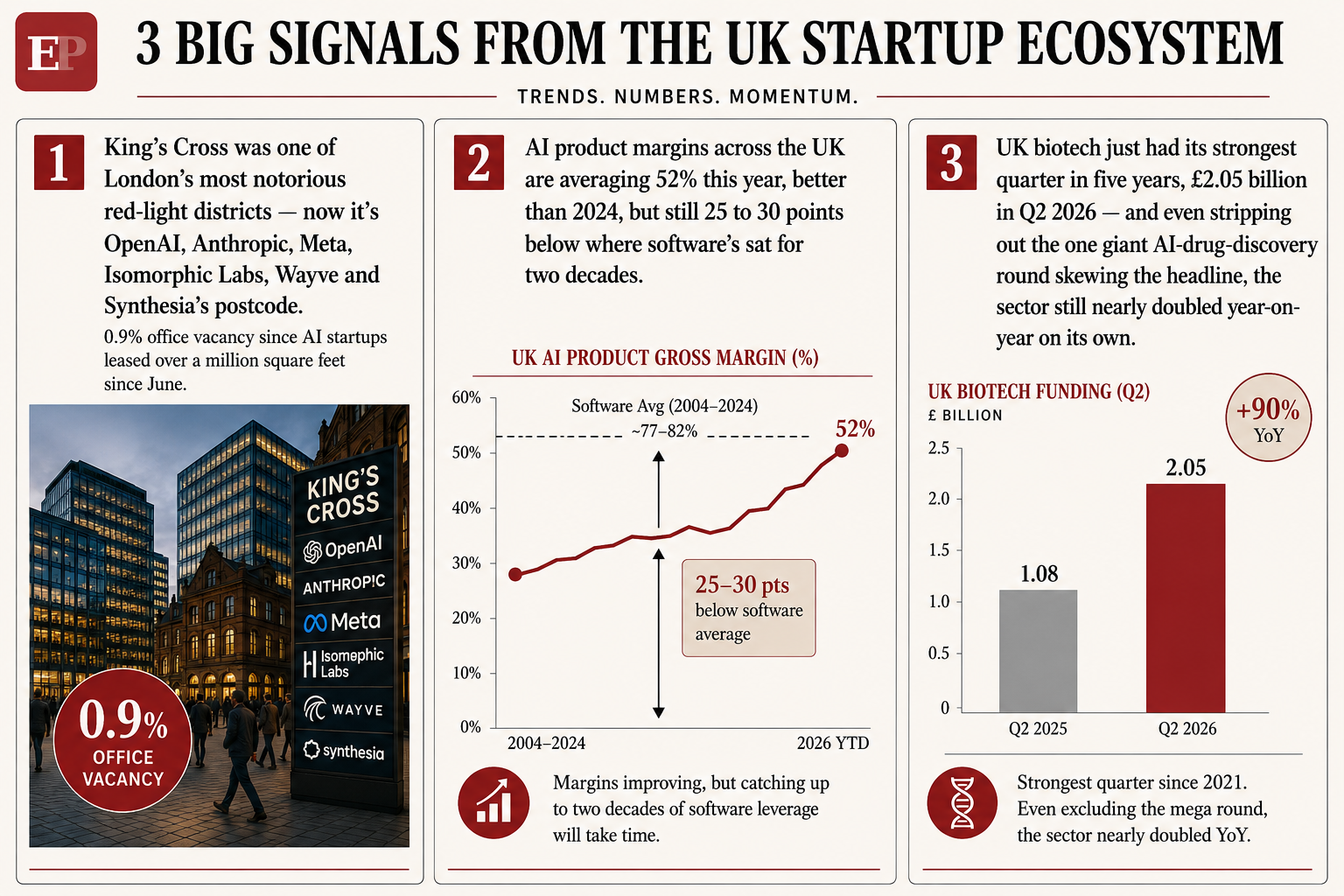
→ King's Cross was one of London's most notorious red-light districts , now it's OpenAI, Anthropic, Meta, Isomorphic Labs, Wayve and Synthesia's postcode, with 0.9% office vacancy since AI startups leased over a million square feet since June.
→ AI product margins across the UK are averaging 52% this year, better than 2024, but still 25 to 30 points below where software's sat for two decades.
→ UK biotech just had its strongest quarter in five years, £2.05 billion in Q2 2026, and even stripping out the one giant AI-drug-discovery round skewing the headline, the sector still nearly doubled year-on-year on its own.
Three sectors. Same bet: money is chasing depth over noise.
King's Cross isn't full because AI is trendy, it's full because the problems there don't have shortcuts.
And Biotech just had its best quarter in five years for the same reason.
Whether the returns catch up as fast as the capital did is the question sitting under every story in this edition.
One pattern we noticed
Darktrace didn't get to 89% margins overnight. It took over a decade.
Synthesia is eight years in.
Nobody asked whether the money would work out before they built the thing worth building.
That's either the most reckless part of this story, or the most obvious one.
One number
89%.
That's Darktrace's gross margin.
The UK AI average right now is 52%.
So one is where AI margins can go, and the other is where most of them still are.
Question of the week
Which one do you think most UK AI startups end up looking like in five years:
Darktrace or Synthesia?
We're leaning towards Synthesia.
If you think elsewise, you can contact us with your answer or any other suggestion at- [email protected]
Sources: Synthesia figures drawn from EP+'s own reporting, Synthesia's press releases, and Sacra's 2026 company analysis. Darktrace figures from Summit Partners, Finimize and third-party financial reporting. External figures from Dealroom and HSBC Innovation Banking UK, via Tech Funding News (UK AI funding, H1 2026); TechCrunch (King's Cross); and the BioIndustry Association, via UKTN (UK biotech financing, Q2 2026).


